
Learn math through
stories & curiosity
Expert guides for parents, students and math enthusiasts. Algebra to Olympiads — we've got you covered.
Trending Articles
Most-read posts on the blog
Analytic Geometry: Formulas, Lines, Circles & Conics
Alternating Series Test: Leibniz Rule & Examples
Math For 4 Year Olds: Activities And Milestones
Teaching Place Value To Kids: Simple Activities That Work
Teaching Number Recognition To Toddlers (Parent Guide)
25+ Subtraction Activities For Kids
100+ Sensory Math Activities For Toddlers
100+ Real World Math Activities For Everyday Learning
Alternating Series: Test, Convergence & Error Bound
Absolute Value Functions: Graph, Derivative & Integral
What Is Calculus? Definition, Branches & Examples
Preschool Math Skills: A Parent's Grade Guide
Pre-K Math Milestones: A Parent's Checklist
Trigonometric Substitution: Rules & Examples
Pattern Activities For Kids: 20 Fun Hands-On Ideas
50+ Outdoor Math Activities For Kids To Learn Through Play
Analytic Geometry: Formulas, Lines, Circles & Conics
Alternating Series Test: Leibniz Rule & Examples
Math For 4 Year Olds: Activities And Milestones
Teaching Place Value To Kids: Simple Activities That Work
Teaching Number Recognition To Toddlers (Parent Guide)
25+ Subtraction Activities For Kids
100+ Sensory Math Activities For Toddlers
100+ Real World Math Activities For Everyday Learning
Alternating Series: Test, Convergence & Error Bound
Absolute Value Functions: Graph, Derivative & Integral
What Is Calculus? Definition, Branches & Examples
Preschool Math Skills: A Parent's Grade Guide
Pre-K Math Milestones: A Parent's Checklist
Trigonometric Substitution: Rules & Examples
Pattern Activities For Kids: 20 Fun Hands-On Ideas
50+ Outdoor Math Activities For Kids To Learn Through Play
The goal was never to make kids faster at math — it was to make them fall in love with it. Speed is a byproduct of genuine understanding.

Explore by Topic
Dive into the subject you love most
Algebra
Variables, equations, and the language of math
Coefficient - Definition, Types, and Math Examples
A coefficient is the number that multiplies a variable in an algebraic expression — in 3x, the coefficient is 3. This article covers the formal definition, the four types of coefficients, how to identify them in any expression, the rule for variables with no visible number, and the most common mistakes when picking out the coefficient.
Properties of Logarithms - Laws, Formulas, Proofs
The properties of logarithms are seven identities that simplify logarithmic expressions: the product rule (log b(xy) = log b x + log b y), quotient rule (log b(x/y) = log b x - log b y), power rule (log b(xⁿ) = n log b x), change-of-base formula, and three special values (log b 1 = 0, log b b = 1, log b bⁿ = n).
Roots In Polynomial Expressions: Full Guide
Roots in polynomial expressions are the values of x that make the polynomial equal zero, so a root of P(x) is any x with P(x) = 0. A number r is a root exactly when (x - r) is a factor, and by the Fundamental Theorem of Algebra a degree-n polynomial has exactly n roots when you count multiplicity and allow complex numbers.
Geometry
Shapes, proofs, and spatial thinking
Geometry — Concepts, Formulas, Shapes & Topics Guide
Geometry is the branch of mathematics that studies points, lines, angles, shapes, and space — how figures are built, measured, and related. This hub maps every geometry topic into ten clusters: foundations (points, lines, planes), angles, parallel lines and transversals, triangles, quadrilaterals and polygons, circles, 3D solids, coordinate geometry, conic sections, and transformations — each linking to a full guide with formulas and worked examples.
Constructing an Angle of 60 Degrees: Compass Steps
Constructing an angle of 60 degrees with only a compass and straightedge means building one corner of an equilateral triangle, whose three angles are each 60°. Draw a base ray, sweep an arc from the endpoint, sweep an equal arc from where it crosses, and join the vertex to the intersection. This article shows the step-by-step image series, proves why it lands at exactly 60°, and works through six examples.
Octahedron: Faces, Edges, Vertices & Properties
An octahedron is a polyhedron with 8 faces, and the regular octahedron is a Platonic solid built from 8 equilateral triangles with 12 edges and 6 vertices. This article defines it, shows its properties, its volume and surface-area formulas, how it obeys Euler's formula F - E + V = 2, and worked examples.
Trigonometry
Angles, waves, and circular harmony
Tan 330 Degrees: Exact Value, Radians & Unit Circle
Tan 330 Degrees equals -1/(√3), the same as -(√3)/3, which is about -0.5774. The angle 330^° is (11π)/6 in radians, it sits in the fourth quadrant, and its reference angle is 30^°. Tangent is negative there, so the answer carries a minus sign.
Tan (a + b) Formula: Proof And Examples
The Tan (a + b) identity gives the tangent of a sum of two angles in terms of their separate tangents: tan(a+b) = (tan a + tan b)/(1 - tan a tan b) It is not tan a + tan b. The denominator is what makes the identity work, and the whole expression is undefined whenever tan a tan b = 1 (because that forces a division by zero, matching tan 90^°).
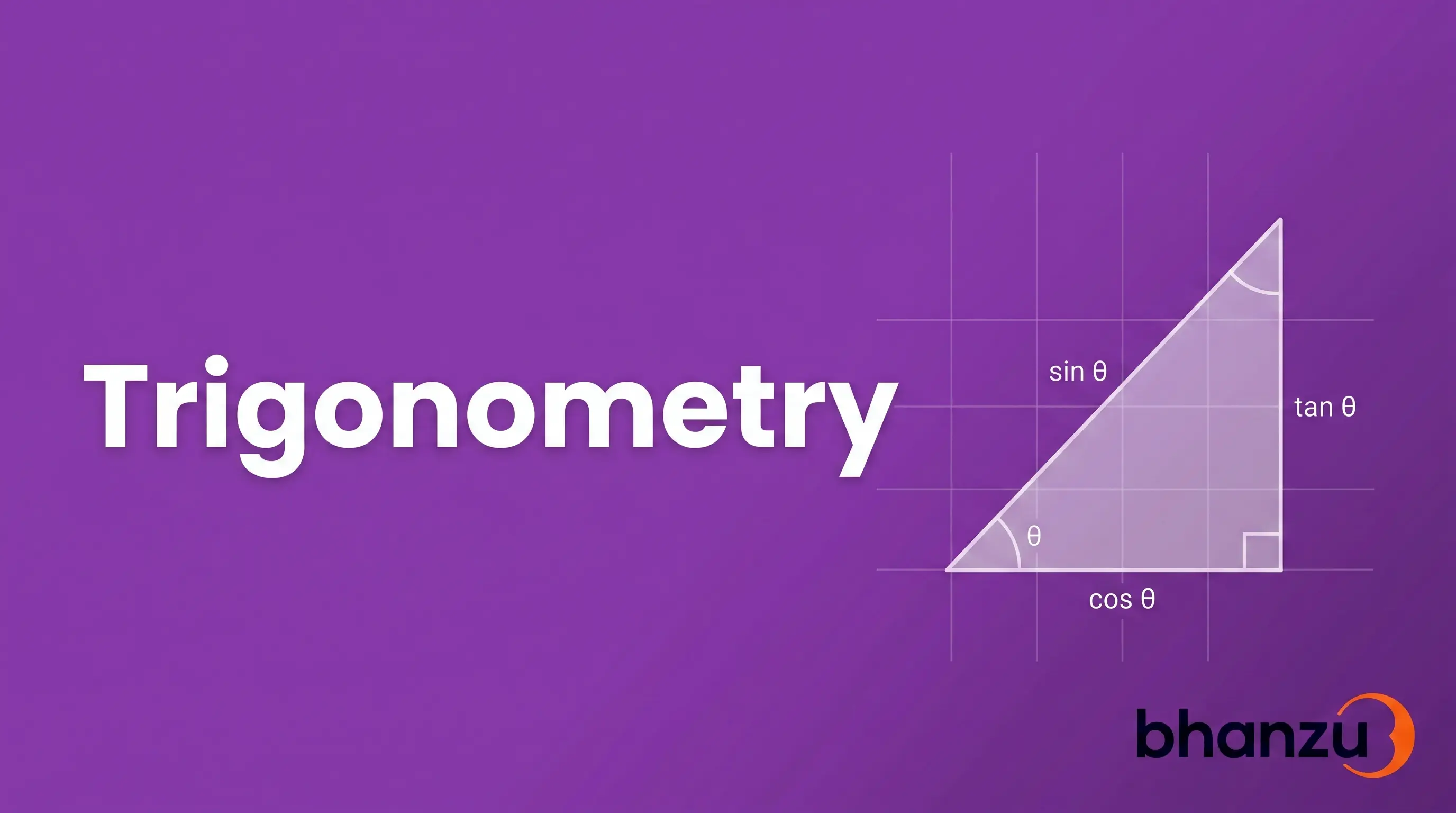
Trigonometry — Complete Guide to Formulas & Identities
This trigonometry complete guide covers the six trig functions (sin, cos, tan, csc, sec, cot), the unit circle, the four families of identities (Pythagorean, reciprocal, sum-and-difference, double-angle), the six inverse trig functions and the standard derivatives.
Parenting
Raising confident, curious young mathematicians
Math Formulas
Every essential formula, explained and derived
Percentile Formula – Definition, Calculation, Examples
The percentile formula tells you where a value stands in a dataset: P = (number of values below x)/N × 100. This article covers both directions — finding the percentile of a value, and finding the value at a given percentile — with worked examples, the percentile-versus-percentage distinction, and the mistakes that trip students up.
Maths Formulas for Class 10 — Chapter-Wise List
The maths formulas for class 10 span the full board syllabus — real numbers, polynomials, linear and quadratic equations, arithmetic progressions, triangles, coordinate geometry, trigonometry, circles, mensuration, statistics, and probability. This hub lists every formula by chapter, explains where each one comes from, and works one example per cluster so the formulas connect instead of floating loose.
nPr Formula — Permutations, Derivation, Examples
The nPr formula counts how many ordered arrangements of r objects you can make from n distinct objects: ⁿP r = (n!)/((n-r)!). This article derives that formula from the counting principle, defines every symbol, shows where order makes a permutation different from a combination, and works six examples from a simple line-up to a locked-position arrangement.
Math Terms
Crystal-clear definitions with worked examples
CP Formula — How to Find Cost Price, Examples
The CP formula recovers the cost price of an item from its selling price and a profit or loss: CP = SP - profit, CP = SP + loss, and from a percentage, CP = 100/(100 + profit%) × SP or 100/(100 - loss%) × SP. This article derives all four forms, defines every term, and works six examples plus the percentage mistakes that flip answers.
Isosceles Triangle Formula — Area, Perimeter, Height
The isosceles triangle formula set is: area = 1/2bh (or b/2√(a² - (b²)/4) from the equal side a and base b), perimeter = 2a + b, and height = √(a² - (b²)/4). This article gives each formula, derives the height and area straight from the Pythagorean theorem, works six examples from one-step to a word problem, and clears up the mistakes that cost the most marks.
What Is a Chord? Definition, Properties & Examples
A chord is a straight line segment whose two endpoints both lie on a curve — most often a circle. This article defines the term, gives the chord-length formulas, lays out the key chord properties, works six examples, and clears up the chord-versus-diameter mix-up that trips students.
Help your child go from fearing math to loving it
Live, personalized classes from instructors trained by the World's Fastest Human Calculator. Join 70,000+ students who learn math the curious way.