What Does Cos 40 Degrees Mean?
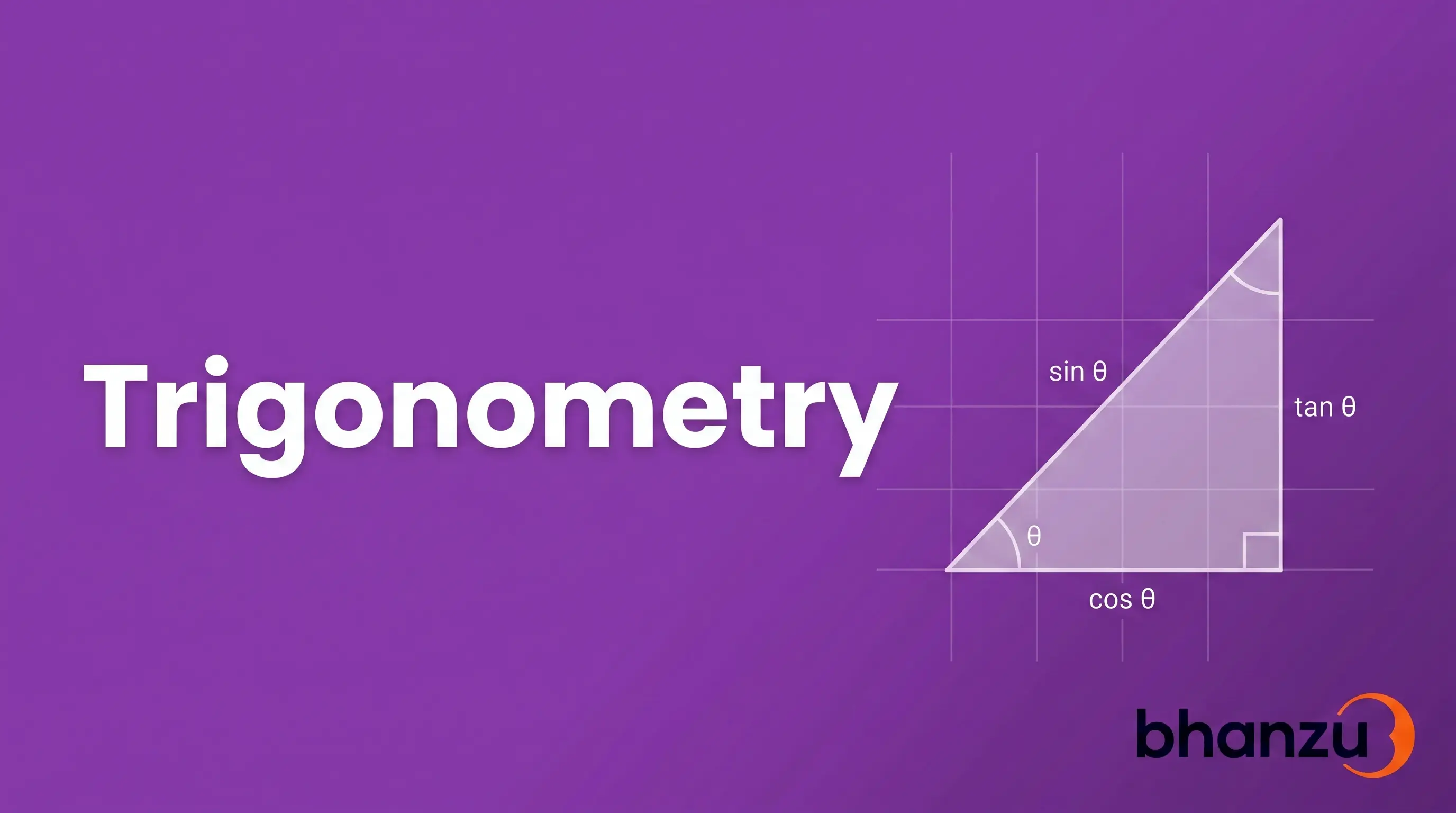
Cosine is one of the three core trigonometric ratios - in a right triangle, the cosine of an angle is the side adjacent to it divided by the hypotenuse. So $\cos 40^\circ$ asks: in a right triangle with a $40^\circ$ angle, what fraction of the hypotenuse is the adjacent side? The answer is about $0.766$.
On the unit circle, $\cos 40^\circ$ is the $x$-coordinate of the point at $40^\circ$, roughly $(0.766, 0.643)$, sitting in the first quadrant where cosine is positive. In radian measure the same angle is $\dfrac{2\pi}{9}$.
Where Does Cos 40 Degrees Show Up?
A $40^\circ$ angle appears in real measurement all the time - a roof pitch, a camera tilt, a slope survey, the elevation of the sun in mid-morning. The horizontal reach of anything leaning at $40^\circ$ scales with $\cos 40^\circ \approx 0.766$, so a $1$-metre pole tilted $40^\circ$ from vertical casts its base $0.766$ m out.
Because $40^\circ$ is not a special angle, engineers and students reach for a calculator or a table rather than a memorised fraction. The cosine function still returns a precise number; it just is not a tidy one, which is the honest situation for most real-world angles.
Standard-Angle Reference Table
Forty degrees falls between two special angles, $30^\circ$ and $45^\circ$, but it is not one of them. The table shows why: the special angles have clean radical forms, and $40^\circ$ does not.
Angle (degrees) | $\cos\theta$ (exact) | $\cos\theta$ (decimal) |
|---|---|---|
$30^\circ$ | $\dfrac{\sqrt{3}}{2}$ | $0.8660$ |
$40^\circ$ | no simple radical | $0.7660$ |
$45^\circ$ | $\dfrac{\sqrt{2}}{2}$ | $0.7071$ |
$60^\circ$ | $\dfrac{1}{2}$ | $0.5000$ |
Cosine shrinks as the angle grows, so $\cos 40^\circ = 0.7660$ correctly sits between $\cos 30^\circ = 0.8660$ and cos 45 degrees $= 0.7071$. It is a value you look up or compute, not one you memorise as a radical.
How Do You Find The Value Of Cos 40 Degrees?
Since $40^\circ$ is not a special angle, the practical route is a calculator, and the interesting question is why there is no clean exact form.
Method 1: Calculator or table.
Set the calculator to degree mode and enter $\cos(40)$, which returns $0.76604444\ldots$. For most work, $0.7660$ is enough precision.
$$\cos 40^\circ \approx 0.7660$$
Method 2: The cofunction shortcut.
Cosine and sine are cofunctions: $\cos\theta = \sin(90^\circ - \theta)$. So $\cos 40^\circ = \sin 50^\circ$, which is useful when a problem or table gives you the sine of the complementary angle instead.
$$\cos 40^\circ = \sin(90^\circ - 40^\circ) = \sin 50^\circ \approx 0.7660$$
Method 3: Why there is no simple radical (the triple-angle reason).
The triple-angle identity says $\cos 3\theta = 4\cos^3\theta - 3\cos\theta$. Put $\theta = 40^\circ$, so $3\theta = 120^\circ$ and $\cos 120^\circ = -\dfrac{1}{2}$:
$$4\cos^3 40^\circ - 3\cos 40^\circ = -\frac{1}{2}$$
This is a cubic in $\cos 40^\circ$ whose solution cannot be written with real square roots alone — the classic reason $40^\circ$ has no clean surd form, unlike $30^\circ$ or $45^\circ$. Any exact expression needs cube roots of complex numbers, so the decimal is the sensible answer. The full catalogue of which angles do and do not have simple forms is documented in exact trigonometric values.
Examples Of Cos 40 Degrees
Example 1
Evaluate $10\cos 40^\circ$ to three decimal places.
$$10\cos 40^\circ = 10 \times 0.76604 = 7.660$$
Example 2
A student is asked for the exact value of $\cos 40^\circ$ and writes $\dfrac{\sqrt{2}}{2}$.
Wrong attempt. Seeing that $40^\circ$ is close to $45^\circ$, the student borrows the $45^\circ$ radical and writes $\cos 40^\circ = \dfrac{\sqrt{2}}{2} \approx 0.7071$.
That breaks against the value: $\cos 40^\circ \approx 0.7660$, not $0.7071$. "Close to a special angle" does not mean "equal to a special angle," and the $0.06$ gap is large enough to fail a check.
Correct. There is no simple radical for $\cos 40^\circ$. State the decimal $0.7660$, or leave it as $\cos 40^\circ$ if an exact symbol is required.
Example 3
A right triangle has a hypotenuse of $12$ cm and a $40^\circ$ angle. Find the adjacent side.
$$\cos 40^\circ = \frac{\text{adjacent}}{12} \implies \text{adjacent} = 12 \times 0.7660 = 9.192 \text{ cm}$$
Example 4
Use the cofunction relationship to write $\cos 40^\circ$ as a sine.
Since $\cos\theta = \sin(90^\circ - \theta)$:
$$\cos 40^\circ = \sin 50^\circ \approx 0.7660$$
This is why a table of sines can answer a cosine question, and vice versa, through complementary angles.
Example 5
A ladder leans so it makes $40^\circ$ with the ground. Its foot is $2$ m from the wall. How long is the ladder?
The adjacent side to the $40^\circ$ angle is the ground distance, $2$ m, so:
$$\cos 40^\circ = \frac{2}{\text{ladder}} \implies \text{ladder} = \frac{2}{0.7660} \approx 2.611 \text{ m}$$
Where Students Trip Up On Cos 40 Degrees
Mistake 1: Forcing a special-angle radical
Where it slips in: Exact-value questions, when a reader assumes every angle has a clean surd form like the special angles do.
Don't do this: Writing $\cos 40^\circ = \dfrac{\sqrt{2}}{2}$ or inventing a radical because $40^\circ$ looks tidy.
The correct way: Only $0^\circ, 30^\circ, 45^\circ, 60^\circ, 90^\circ$ (and their relatives) carry simple radicals. For $40^\circ$, use the decimal $0.7660$. Students who over-generalise the special-angle table apply it to angles that were never on it.
Mistake 2: Leaving the calculator in radian mode
Where it slips in: Entering $\cos(40)$ without checking the angle mode.
Don't do this: Trusting the screen when a calculator left in radian mode returns $\cos(40) \approx -0.6669$ instead of $0.7660$.
The correct way: Confirm degree mode before entering $\cos(40)$. A result far outside the expected $0.7$–$0.8$ range is the tell that the mode is wrong.
Mistake 3: Over-rounding too early
Where it slips in: Multi-step problems, where $\cos 40^\circ$ is rounded to $0.8$ before further arithmetic.
Don't do this: Using $0.8$ for $\cos 40^\circ$ and letting a $0.034$ error compound through several multiplications.
The correct way: Keep at least four decimals, $0.7660$, through the working and round only the final answer. For non-special angles, precision is a habit, not a formula.
Frequently Asked Questions
What is the value of cos 40 degrees? Approximately $0.7660$. There is no simple exact radical because $40^\circ$ is not a special angle.
Is cos 40 degrees a rational number? No. Its decimal $0.76604444\ldots$ does not terminate or repeat, so it is irrational.
What is cos 40 degrees in radians? The angle $40^\circ$ equals $\dfrac{2\pi}{9}$ radians, and $\cos \dfrac{2\pi}{9} \approx 0.7660$ - the same value, just a different unit for the angle.
Is cos 40 the same as sin 50? Yes. Cosine and sine are cofunctions, so $\cos 40^\circ = \sin 50^\circ \approx 0.7660$.
Why does cos 40 have no exact value like cos 30? Its cosine solves a cubic (from the triple-angle identity to $\cos 120^\circ$) that cannot be written with real square roots - so it needs a decimal, not a surd.
Key Takeaways
Cos 40 degrees is approximately $0.7660$ - a decimal, not a special-angle radical.
It sits correctly between $\cos 30^\circ = 0.8660$ and $\cos 45^\circ = 0.7071$, and equals $\sin 50^\circ$ by the cofunction rule.
Treat $\cos 40^\circ$ as a calculator or table value, and keep four decimals through multi-step work.
To build calculator-angle fluency with a teacher, explore Bhanzu's trigonometry tutor, a high school math tutor, or live math classes online.
Practice These Before Moving On
Evaluate $5\cos 40^\circ + 2$ to three decimal places.
A slope rises at $40^\circ$ over a horizontal run of $6$ m. Use $\cos 40^\circ$ to find the slope length.
Verify that $\cos 40^\circ$ and $\sin 50^\circ$ agree to four decimals.
Want a live Bhanzu trainer to walk through more cos 40 degrees problems? Book a free demo class.
Read More
Cos 25 Degrees — another non-special angle handled as a decimal value.
Cos 20 Degrees — a nearby small angle with the same triple-angle backstory.
Cos 65 Degrees — the cofunction partner, since $\cos 65^\circ = \sin 25^\circ$.
Trigonometric Table — sine, cosine, and tangent for every standard angle in one chart.

Was this article helpful?
Your feedback helps us write better content