What Does Cos 50 Degrees Mean?
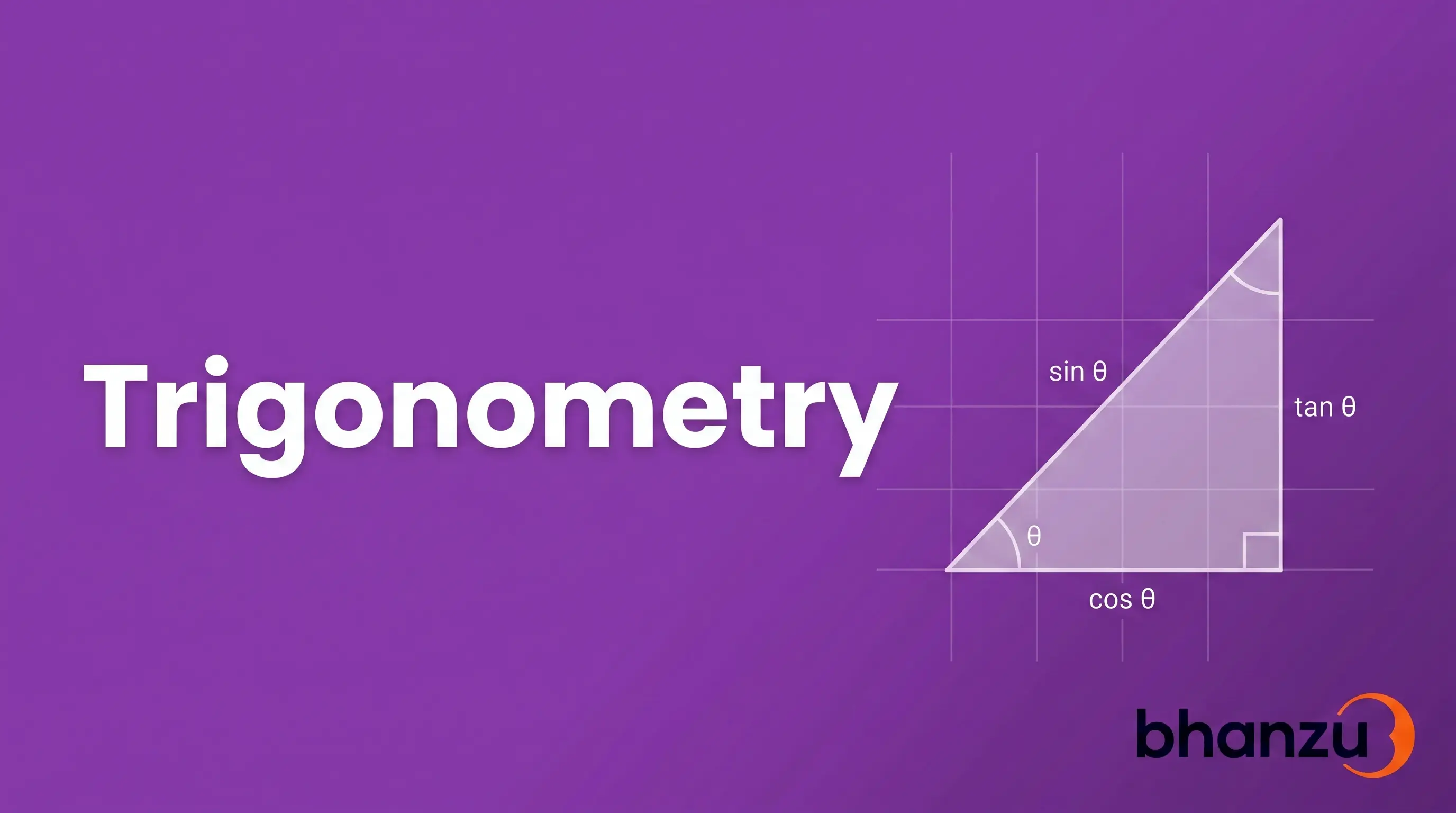
Cosine is one of the three core trigonometric ratios: in a right triangle, the cosine of an angle is the side adjacent to it divided by the hypotenuse. So $\cos 50^\circ$ asks what fraction of the hypotenuse the adjacent side is when the angle is $50^\circ$.
On the unit circle, the cosine of an angle is the $x$-coordinate of the point where the angle's radius meets the circle. At $50^\circ$ that point is about $(0.6428, 0.766)$, and since $50^\circ$ lies in the first quadrant, the cosine is positive. The cosine function returns this same $0.6428$ every time the angle comes back to $50^\circ$.
Where Does Cos 50 Degrees Show Up?
A $50^\circ$ angle is common in the physical world even though its cosine is not a special value. A roof pitched at $50^\circ$, a support strut leaning at $50^\circ$, or a projectile launched at $50^\circ$ all need $\cos 50^\circ$ to resolve the horizontal component of a length or velocity. Because the answer is a measured decimal, engineers and surveyors read it off a calculator to the precision the job needs, not off a table of exact forms.
Standard-Angle Reference Table
Fifty degrees sits between two special angles, and comparing them shows why its cosine is a plain decimal rather than a tidy radical.
Angle (degrees) | $\cos\theta$ (exact) | $\cos\theta$ (decimal) |
|---|---|---|
$30^\circ$ | $\dfrac{\sqrt{3}}{2}$ | $0.8660$ |
$45^\circ$ | $\dfrac{\sqrt{2}}{2}$ | $0.7071$ |
$50^\circ$ | no simple radical | $0.6428$ |
$60^\circ$ | $\dfrac{1}{2}$ | $0.5000$ |
Cosine shrinks as the angle grows, so $\cos 50^\circ$ lands between cos 45 degrees and cos 60 degrees - closer to the middle of that gap. Unlike its neighbours, $50^\circ$ carries no clean surd, which is exactly what makes it a calculator value rather than one to memorise.
How Do You Find The Exact Value Of Cos 50 Degrees?
Here is the honest answer: $50^\circ$ is not a special angle, so there is no short exact form to write down. A closed form exists, but it is a messy nested radical from solving a cubic, and no exam expects it. Finding $\cos 50^\circ$ is a calculator and approximation skill, not a memorisation target. Three routes get you a trustworthy number.
Method 1: The calculator.
Set the calculator to degree mode and enter $\cos(50)$:
$$\cos 50^\circ = 0.642787\ldots \approx 0.6428$$
Method 2: The cofunction relationship.
Cosine and sine are cofunctions, linked by the cofunction identities: $\cos\theta = \sin(90^\circ - \theta)$. So
$$\cos 50^\circ = \sin(90^\circ - 50^\circ) = \sin 40^\circ \approx 0.6428$$
This does not make $50^\circ$ special, but it lets you swap in a sine value if that is what your problem gives you.
Method 3: Bounding between special angles.
You can sanity-estimate without a calculator. Since $\cos 45^\circ \approx 0.7071$ and $\cos 60^\circ = 0.5$, and $50^\circ$ sits between them, $\cos 50^\circ$ must fall between $0.5$ and $0.7071$. The decimal $0.6428$ passes that check. For the precise definition of cosine as a function, see Wolfram MathWorld's cosine entry.
Examples Of Cos 50 Degrees
Example 1
Evaluate $10\cos 50^\circ$.
$$10\cos 50^\circ = 10 \times 0.6428 = 6.428$$
Example 2
Find $\cos 50^\circ$ without a calculator by splitting the angle.
Wrong attempt. A student writes $\cos 50^\circ = \cos 45^\circ + \cos 5^\circ \approx 0.7071 + 0.9962 = 1.7033$.
That is impossible: cosine never exceeds $1$, so an answer above $1.7$ is wrong on sight. Cosine is not additive, so $\cos(45^\circ + 5^\circ)$ is not $\cos 45^\circ + \cos 5^\circ$.
Correct. The angle-sum identity is $\cos(A + B) = \cos A\cos B - \sin A\sin B$:
$$\cos 50^\circ = \cos 45^\circ\cos 5^\circ - \sin 45^\circ\sin 5^\circ \approx 0.7044 - 0.0617 = 0.6427$$
which matches the calculator value.
Example 3
Verify that $\cos 50^\circ = \sin 40^\circ$.
$$\sin 40^\circ \approx 0.6428 = \cos 50^\circ$$
The cofunction relationship holds because $50^\circ$ and $40^\circ$ are complementary.
Example 4
A brace leans against a wall with its foot $8$ m from the base, meeting the ground at $50^\circ$. How long is the brace?
The horizontal run is the adjacent side, so:
$$\cos 50^\circ = \frac{8}{\text{brace}} \implies \text{brace} = \frac{8}{0.6428} \approx 12.45 \text{ m}$$
Example 5
Check that $\cos^2 50^\circ + \sin^2 50^\circ = 1$.
$$(0.6428)^2 + (0.766)^2 = 0.4132 + 0.5868 = 1.0000$$
The Pythagorean identity holds for $50^\circ$ as it does for every angle.
Where Students Trip Up On Cos 50 Degrees
Mistake 1: Inventing a radical for a non-special angle
Where it slips in: Seeing $50^\circ$ near $45^\circ$ and $60^\circ$ and assuming it must have a clean surd too.
Don't do this: Writing something like $\cos 50^\circ = \dfrac{\sqrt{2.6}}{2}$. The first instinct for many students is to force every angle into a radical, but only a short list of angles has one.
The correct way: Report $\cos 50^\circ \approx 0.6428$ and say plainly that $50^\circ$ has no simple exact form. Rounding to a decimal is the right answer here, not a shortcoming.
Mistake 2: Adding cosines of split angles
Where it slips in: Breaking $50^\circ$ into $45^\circ + 5^\circ$ and adding the cosines.
Don't do this: Writing $\cos(45^\circ + 5^\circ) = \cos 45^\circ + \cos 5^\circ$, which gives a value above $1$.
The correct way: Use $\cos(A + B) = \cos A\cos B - \sin A\sin B$. Cosine mixes the two angles, it does not add across them.
Mistake 3: Reading the answer in radian mode
Where it slips in: A calculator left in radian mode returns $\cos(50) \approx 0.965$ instead of $0.6428$.
Don't do this: Trusting the screen without confirming the angle unit.
The correct way: Confirm degree mode before entering $\cos(50)$. Radian-versus-degree confusion is a well-known source of error in engineering and graphics software, where an angle fed in the wrong unit silently produces a wrong length - the fix is always to check the unit first.
Key Takeaways
Cos 50 degrees is approximately $0.6428$ - a decimal value, because $50^\circ$ is not a special angle and has no simple radical.
It sits between $\cos 45^\circ \approx 0.7071$ and $\cos 60^\circ = 0.5$, a quick way to sanity-check the number.
$\cos 50^\circ = \sin 40^\circ$ through the cofunction relationship of complementary angles.
The common slips are inventing a radical, adding cosines of split angles, and leaving the calculator in radian mode.
To build angle sense with a teacher, explore Bhanzu's trigonometry tutor sessions, a high school math tutor, or a math tutor for one-to-one practice.
Practice These Before Moving On
Estimate $\cos 55^\circ$ by bounding it between $\cos 45^\circ$ and $\cos 60^\circ$, then check with a calculator.
A rope meets the ground at $50^\circ$ and is $15$ m long. Find its horizontal reach using $\cos 50^\circ$.
Use the cofunction relationship to rewrite $\cos 50^\circ$ as a sine, then confirm the two decimals match.
Want a live Bhanzu trainer to work through non-special angles and calculator technique? Book a free demo class.
Read More
Cos 35 Degrees — another non-special angle handled as a decimal.
Cos 25 Degrees — a smaller non-special angle with a cosine near $0.9063$.
Cos 40 Degrees — the complementary angle whose sine equals $\cos 50^\circ$.
Trigonometric table — cosine values for the standard angles at a glance.
Trigonometric ratios of specific angles — where the clean radicals actually come from.

Was this article helpful?
Your feedback helps us write better content