What Does Cos 90 Degrees Mean?
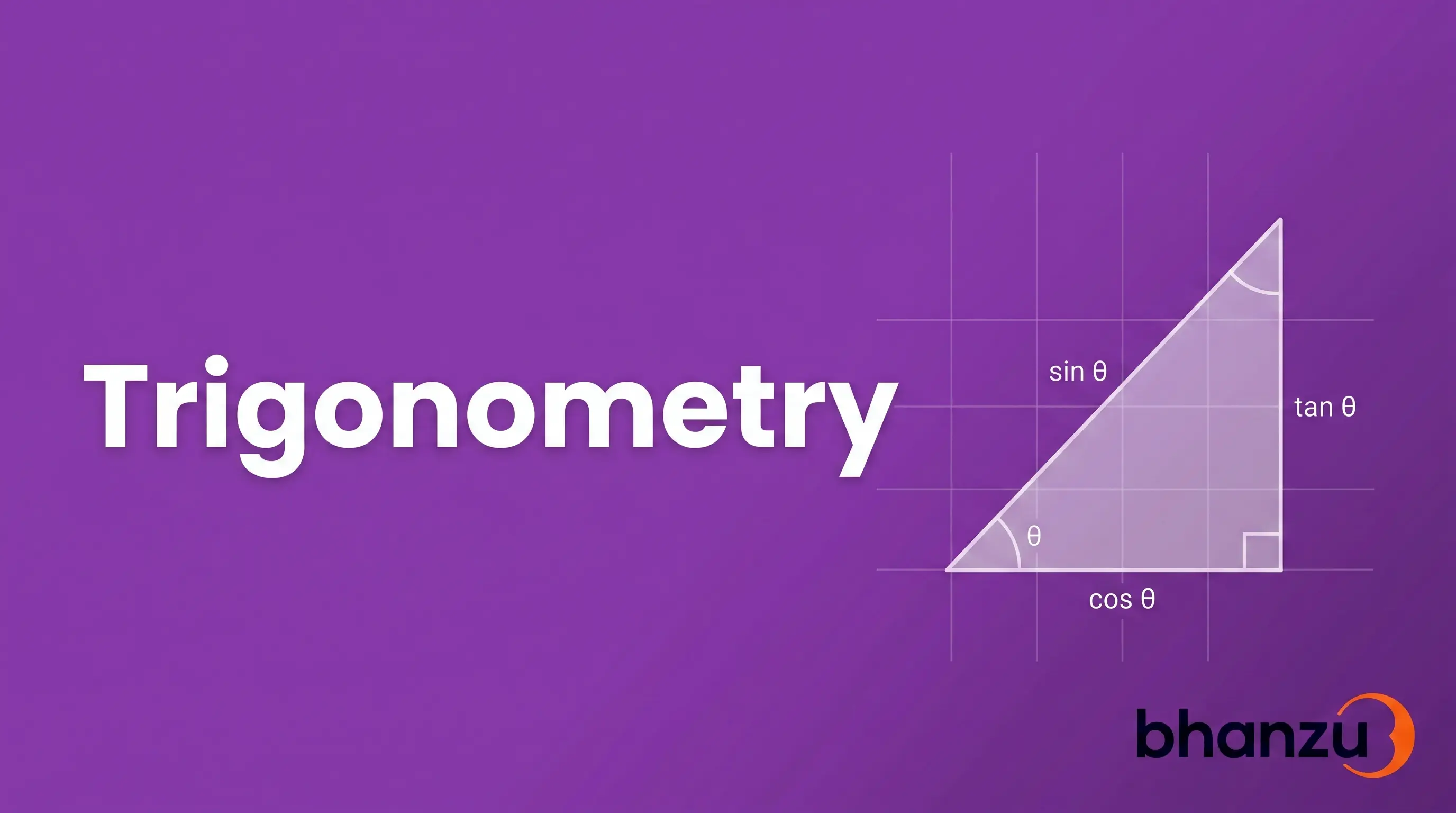
Cosine is one of the three core trigonometric ratios: in a right triangle it is the side adjacent to the angle divided by the hypotenuse. As the angle opens toward a full 90 degree angle, the adjacent side shrinks toward zero while the hypotenuse stays fixed.
On the unit circle, cosine is the $x$-coordinate of the point where the radius meets the circle. At $90^\circ$ that point is $(0, 1)$, so the $x$-coordinate, and therefore the cosine, is $0$.
Where Does Cos 90 Degrees Show Up?
A force pushed straight up has no sideways pull, and that is exactly $\cos 90^\circ = 0$ at work: the horizontal component of a vertical push is zero. Any two directions at a right angle are said to be orthogonal, and cosine being $0$ is the algebraic signal of that.
On the unit circle, $90^\circ$ is the top point $(0, 1)$, the moment the radius has turned fully onto the vertical axis and its shadow on the $x$-axis has shrunk to nothing.
Standard-Angle Reference Table
Ninety degrees is where cosine reaches the bottom of its first-quadrant slide. Here are the standard angles in both degrees and radians.
Angle (degrees) | Angle (radians) | $\cos\theta$ (exact) | $\cos\theta$ (decimal) |
|---|---|---|---|
$0^\circ$ | $0$ | $1$ | $1.0000$ |
$30^\circ$ | $\dfrac{\pi}{6}$ | $\dfrac{\sqrt{3}}{2}$ | $0.8660$ |
$45^\circ$ | $\dfrac{\pi}{4}$ | $\dfrac{\sqrt{2}}{2}$ | $0.7071$ |
$60^\circ$ | $\dfrac{\pi}{3}$ | $\dfrac{1}{2}$ | $0.5000$ |
$90^\circ$ | $\dfrac{\pi}{2}$ | $0$ | $0.0000$ |
Read the column downward and cosine slides from $1$ to $0$. The radian twin of this value lives at cos pi/2, the same $0$ reached from the radian $\dfrac{\pi}{2}$.
How Do You Find The Exact Value Of Cos 90 Degrees?
At exactly $90^\circ$ the right triangle collapses, so the unit circle is the home definition rather than a triangle.
Method 1: The unit circle.
Rotate the radius $90^\circ$ from the positive $x$-axis and it points straight up, landing at $(0, 1)$. Cosine is the $x$-coordinate:
$$\cos 90^\circ = x\text{-coordinate of }(0, 1) = 0$$
Method 2: The shrinking-adjacent pattern.
Read the reference table as the angle grows: cosine runs $1, \dfrac{\sqrt{3}}{2}, \dfrac{\sqrt{2}}{2}, \dfrac{1}{2}, 0$. The adjacent side keeps shrinking as the angle opens, and at $90^\circ$ it has vanished, so the ratio is $0$.
Both routes agree: the cosine of a right angle is $0$.
Examples Of Cos 90 Degrees
Example 1
Evaluate $7\cos 90^\circ + 3$.
$$7\cos 90^\circ + 3 = 7 \times 0 + 3 = 3$$
Example 2
A student is told $\sin 90^\circ = 1$ and assumes cosine behaves the same way, writing $\cos 90^\circ = 1$. Where does that break?
Wrong attempt. Reasoning that both functions "max out" at $90^\circ$, the student writes $\cos 90^\circ = 1$.
That breaks on the unit circle: the $90^\circ$ point is $(0, 1)$, so the height is $1$ (that is sine) while the horizontal reach is $0$ (that is cosine). Sine and cosine are not interchangeable here.
Correct. $\sin 90^\circ = 1$ but $\cos 90^\circ = 0$. Cosine reads the $x$-coordinate, which is $0$ at the top of the circle.
Example 3
Simplify $\dfrac{5\cos 90^\circ}{\sin 90^\circ}$.
$$\frac{5\cos 90^\circ}{\sin 90^\circ} = \frac{5 \times 0}{1} = 0$$
Example 4
Verify $\cos^2 90^\circ + \sin^2 90^\circ = 1$.
$$0^2 + 1^2 = 0 + 1 = 1$$
The Pythagorean identity holds even at the boundary angle.
Example 5
Why is $\tan 90^\circ$ undefined, given $\cos 90^\circ = 0$?
Tangent is $\dfrac{\sin\theta}{\cos\theta}$, so $\tan 90^\circ = \dfrac{1}{0}$. Division by zero is undefined, which is why tangent has a vertical asymptote at $90^\circ$.
Where Students Trip Up On Cos 90 Degrees
Mistake 1: Swapping cos 90 and sin 90
Where it slips in: Assuming both functions reach their maximum at $90^\circ$.
Don't do this: Writing $\cos 90^\circ = 1$.
The correct way: At $90^\circ$ sine is $1$ and cosine is $0$. The student who reads the unit-circle point $(0, 1)$ as height-then-width stops confusing the two, because cosine is the $x$-coordinate, which is $0$.
Mistake 2: Dividing by cos 90 without noticing it is zero
Where it slips in: Simplifying an expression that hides a $\cos 90^\circ$ in a denominator.
Don't do this: Treating $\dfrac{1}{\cos 90^\circ}$ as an ordinary number.
The correct way: $\dfrac{1}{\cos 90^\circ} = \dfrac{1}{0}$ is undefined; this is exactly why $\sec 90^\circ$ and $\tan 90^\circ$ do not exist.
Mistake 3: Leaving the calculator in radian mode
Where it slips in: Entering $\cos(90)$ on a calculator set to radians.
Don't do this: Trusting the reading of about $-0.448$.
The correct way: Confirm degree mode before entering $\cos(90)$; a result that is not $0$ signals the mode is wrong.
Key Takeaways
Cos 90 degrees equals $0$, exactly, read as the $x$-coordinate of the unit-circle point $(0, 1)$.
In radians, $\cos 90^\circ = \cos\left(\dfrac{\pi}{2}\right)$.
Because $\cos 90^\circ = 0$, both $\tan 90^\circ$ and $\sec 90^\circ$ are undefined.
The most common slip is swapping it with $\sin 90^\circ = 1$; cosine is the width, not the height.
To build unit-circle confidence with a teacher, explore Bhanzu's trigonometry tutor, its high school math tutor programme, or live math classes online.
Practice These Before Moving On
Evaluate $4\cos 90^\circ + 6\cos 0^\circ$.
Explain in one line why $\sec 90^\circ$ does not exist.
State the exact values of $\cos 90^\circ$, $\sin 90^\circ$, and $\tan 90^\circ$ (or "undefined").
Want a live Bhanzu trainer to walk through more cos 90 degrees problems? Book a free demo class.
Read More
Cos 60 Degrees — the standard angle just before $90^\circ$, valued $\dfrac{1}{2}$.
Cos 180 Degrees — the half-turn value, $\cos 180^\circ = -1$.
Sin, Cos, Tan — how the three ratios are defined together.
Trigonometric Table — every standard angle in one chart.
Reference Angle — how angles past $90^\circ$ borrow a first-quadrant value.

Was this article helpful?
Your feedback helps us write better content