What Does Cos pi/3 Mean?
On the unit circle, cosine is the $x$-coordinate of the point where the angle's radius meets the circle. Sweep the radius counterclockwise by $\dfrac{\pi}{3}$ from the positive $x$-axis and it lands at $\left(\dfrac{1}{2}, \dfrac{\sqrt{3}}{2}\right)$, so the cosine is $\dfrac{1}{2}$.
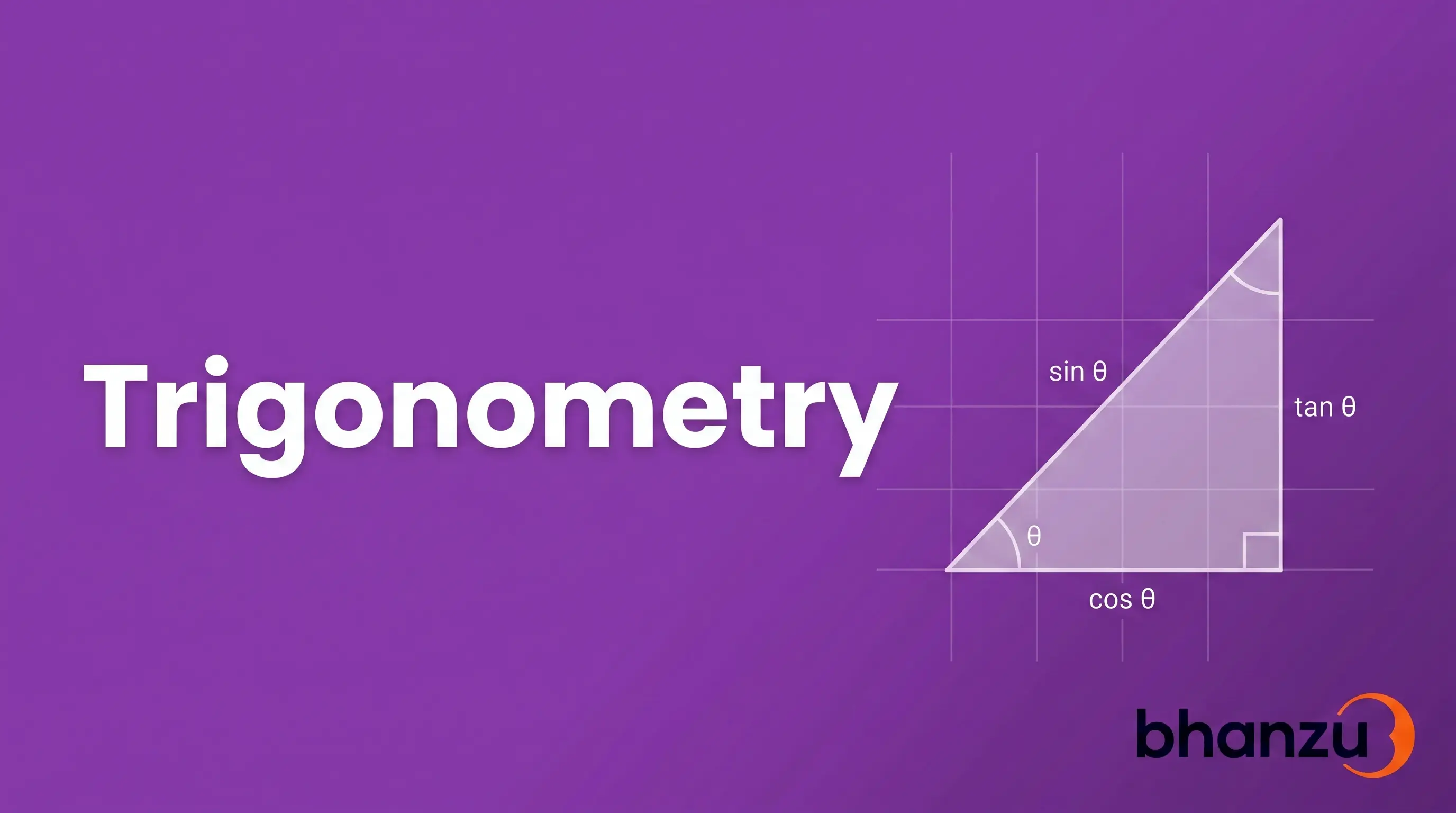
The same value also comes from the trigonometric ratios in a right triangle, where $\dfrac{\pi}{3}$ is the $60^\circ$ corner and cosine is adjacent over hypotenuse. Radians and degrees name the same angle here - only the unit differs.
Where Does Cos pi/3 Show Up?
Physics and engineering usually run on radians, so $\cos\left(\dfrac{\pi}{3}\right)$ appears whenever an angle of one-sixth of a half-turn resolves a quantity. A phase or force set at $\dfrac{\pi}{3}$ keeps exactly half its magnitude along the reference axis.
The value also anchors the geometry of the hexagon and any six-fold symmetry, where each spoke sits $\dfrac{\pi}{3}$ apart around the unit circle.
Standard-Angle Reference Table
A radian measures an angle by arc length rather than degrees, and $\dfrac{\pi}{3}$ is one of the standard radian angles with a clean cosine. Here is the first-quadrant set.
Angle (radians) | Angle (degrees) | $\cos\theta$ (exact) | $\cos\theta$ (decimal) |
|---|---|---|---|
$0$ | $0^\circ$ | $1$ | $1.0000$ |
$\dfrac{\pi}{6}$ | $30^\circ$ | $\dfrac{\sqrt{3}}{2}$ | $0.8660$ |
$\dfrac{\pi}{4}$ | $45^\circ$ | $\dfrac{\sqrt{2}}{2}$ | $0.7071$ |
$\dfrac{\pi}{3}$ | $60^\circ$ | $\dfrac{1}{2}$ | $0.5000$ |
$\dfrac{\pi}{2}$ | $90^\circ$ | $0$ | $0.0000$ |
The degree twin of this exact value is cos 60 degrees, which reaches the same $\dfrac{1}{2}$ through a 30-60-90 triangle instead of the circle.
How Do You Find The Exact Value Of Cos pi/3?
Method 1: Convert to degrees, then use the triangle.
Radians convert to degrees by multiplying by $\dfrac{180^\circ}{\pi}$:
$$\frac{\pi}{3} \times \frac{180^\circ}{\pi} = 60^\circ$$
In a 30-60-90 triangle the side adjacent to $60^\circ$ is half the hypotenuse, so $\cos 60^\circ = \dfrac{1}{2}$. Full conversion detail lives at radians to degrees.
Method 2: Read the unit circle directly.
Sweep the radius by $\dfrac{\pi}{3}$ and take the $x$-coordinate of the landing point.
$$\cos\left(\frac{\pi}{3}\right) = x\text{-coordinate of }\left(\frac{1}{2}, \frac{\sqrt{3}}{2}\right) = \frac{1}{2}$$
Both routes give $\dfrac{1}{2}$, because the unit-circle point and the triangle ratio describe the same $60^\circ$ opening.
Examples Of Cos pi/3
Example 1
Evaluate $4\cos\left(\dfrac{\pi}{3}\right)$.
$$4\cos\left(\frac{\pi}{3}\right) = 4 \times \frac{1}{2} = 2$$
Example 2
A student evaluates $\cos\left(\dfrac{\pi}{3}\right)$ by typing $\cos(\pi/3)$ into a calculator set to degrees and reads $\approx 1.0$. What went wrong?
Wrong attempt. Reading the screen, the student records $\cos\left(\dfrac{\pi}{3}\right) \approx 1$.
That cannot be right: $\cos$ only equals $1$ at an angle of $0$, and $\dfrac{\pi}{3}$ is a real turn away from the axis. The calculator treated the number $\dfrac{\pi}{3} \approx 1.047$ as $1.047$ degrees, an almost-zero angle.
Correct. Switch the calculator to radian mode, or convert first: $\dfrac{\pi}{3} = 60^\circ$, and $\cos 60^\circ = \dfrac{1}{2}$.
Example 3
Verify $\cos^2\left(\dfrac{\pi}{3}\right) + \sin^2\left(\dfrac{\pi}{3}\right) = 1$.
$$\left(\frac{1}{2}\right)^2 + \left(\frac{\sqrt{3}}{2}\right)^2 = \frac{1}{4} + \frac{3}{4} = 1$$
The Pythagorean identity holds for the radian angle exactly as it does for the degree form.
Example 4
A wheel turns through $\dfrac{\pi}{3}$ radians from the horizontal. What fraction of the radius is the horizontal offset of the marked point?
The horizontal offset scales with cosine, so it is $\cos\left(\dfrac{\pi}{3}\right) = \dfrac{1}{2}$ of the radius.
Example 5
Relate $\cos\left(\dfrac{\pi}{3}\right)$ to $\cos\left(\dfrac{2\pi}{3}\right)$.
The angle $\dfrac{2\pi}{3}$ has the same reference angle $\dfrac{\pi}{3}$ but sits in the second quadrant, where cosine is negative. So $\cos\left(\dfrac{2\pi}{3}\right) = -\dfrac{1}{2}$, the sign-flipped partner shown at cos 2pi/3.
Where Students Trip Up On Cos pi/3
Mistake 1: Leaving the calculator in degree mode
Where it slips in: Typing a radian angle into a calculator still set to degrees.
Don't do this: Trusting $\cos(\pi/3) \approx 1$ from the screen.
The correct way: A radian angle needs radian mode. The student who never checks the mode meets a value near $1$ and, if the answer of $\dfrac{1}{2}$ is expected, that gap is the tell.
Mistake 2: Treating pi/3 as pi divided into thirds of a value
Where it slips in: Confusing the angle $\dfrac{\pi}{3}$ with a fraction of $\pi$ the cosine itself.
Don't do this: Writing $\cos\left(\dfrac{\pi}{3}\right) = \dfrac{\cos\pi}{3} = \dfrac{-1}{3}$.
The correct way: $\dfrac{\pi}{3}$ is a single angle, not $\pi$ divided after the cosine. Evaluate the whole angle: $\cos\left(\dfrac{\pi}{3}\right) = \dfrac{1}{2}$.
Mistake 3: Forgetting the quadrant when the angle grows
Where it slips in: Assuming any angle with a $\dfrac{\pi}{3}$ reference keeps the same sign.
Don't do this: Writing $\cos\left(\dfrac{2\pi}{3}\right) = \dfrac{1}{2}$.
The correct way: The reference angle sets the size; the quadrant sets the sign. In the second quadrant cosine is negative, so $\cos\left(\dfrac{2\pi}{3}\right) = -\dfrac{1}{2}$.
Key Takeaways
Cos pi/3 equals $\dfrac{1}{2}$, exactly $0.5$, read off the unit circle as the $x$-coordinate at $\dfrac{\pi}{3}$.
$\dfrac{\pi}{3}$ radians is $60^\circ$, so cos pi/3 and $\cos 60^\circ$ are the same exact value.
The commonest radian error is degree mode on the calculator, which returns a near-$1$ value instead of $\dfrac{1}{2}$.
Reference angle sets size, quadrant sets sign: $\cos\left(\dfrac{2\pi}{3}\right) = -\dfrac{1}{2}$.
To go further with radian trigonometry alongside a teacher, explore Bhanzu's trigonometry tutor, its high school math tutor programme, or math tutoring online.
Practice These Before Moving On
Evaluate $2\cos\left(\dfrac{\pi}{3}\right) + \cos 0$.
Convert $\dfrac{\pi}{3}$ to degrees, then state $\cos$ of that angle.
Without a calculator, decide the sign of $\cos\left(\dfrac{4\pi}{3}\right)$ and give its exact value.
Want a live Bhanzu trainer to walk through more cos pi/3 problems? Book a free demo class.
Read More
Cos pi/2 — the next standard radian angle, where cosine reaches $0$.
Cos pi — the half-turn value, $\cos\pi = -1$.
Sin, Cos, Tan — the three ratios defined together.
Trigonometric Ratios in Radians — reading the standard angles in radian form.
Reference Angle — how larger angles borrow a first-quadrant value.

Was this article helpful?
Your feedback helps us write better content