What Does Cos Pi/4 Mean?
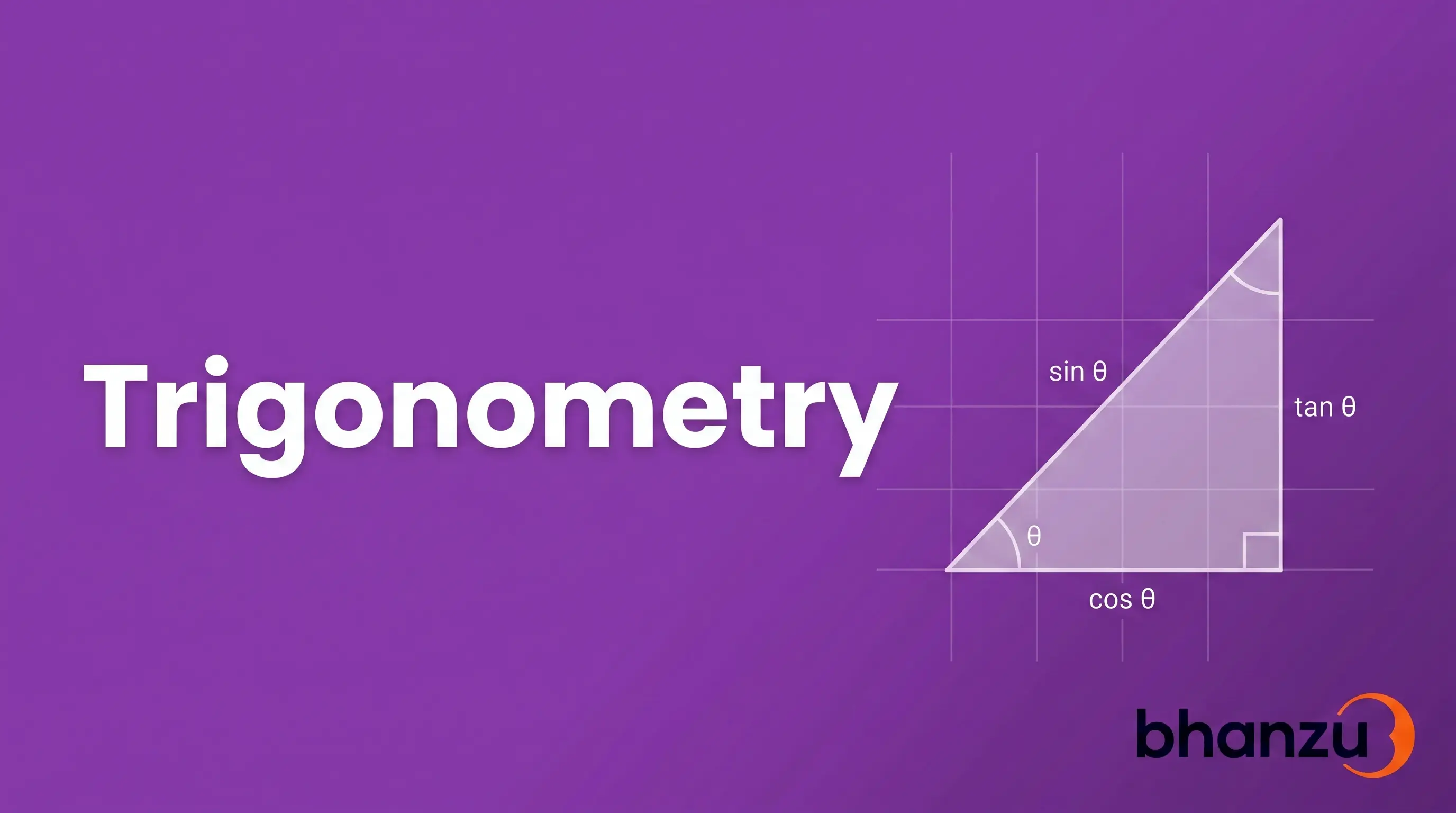
Cosine is one of the three core trigonometric ratios - in a right triangle it is the side adjacent to the angle divided by the hypotenuse. The angle here is written in radians, where a full turn is $2\pi$ and a quarter turn is $\dfrac{\pi}{2}$, so $\dfrac{\pi}{4}$ is an eighth of a turn, or $45^\circ$.
On the unit circle - a circle of radius $1$ centred at the origin - cosine is the $x$-coordinate of the point where the angle's radius meets the circle. At $\dfrac{\pi}{4}$ that point is $\left(\dfrac{\sqrt{2}}{2}, \dfrac{\sqrt{2}}{2}\right)$, so the $x$-coordinate, and the cosine, is $\dfrac{\sqrt{2}}{2}$.
How Do You Find The Exact Value Of Cos Pi/4?
Two routes give the same answer: one builds it from a triangle, the other reads it off the unit circle. Both land on $\dfrac{\sqrt{2}}{2}$.
Method 1: The 45-45-90 triangle.
Take a right triangle with both non-right angles equal to $\dfrac{\pi}{4}$ radians. Because two angles are equal, the two legs are equal - call each leg $1$.
The hypotenuse then follows from the Pythagorean theorem:
$$\text{hypotenuse} = \sqrt{1^2 + 1^2} = \sqrt{2}$$
Now apply the definition of cosine:
$$\cos\frac{\pi}{4} = \frac{\text{adjacent}}{\text{hypotenuse}} = \frac{1}{\sqrt{2}} = \frac{\sqrt{2}}{2}$$
The last step rationalises the denominator by multiplying top and bottom by $\sqrt{2}$; both forms name the same number, and $\dfrac{\sqrt{2}}{2}$ is the standard written form.
Method 2: The unit circle.
Set the radius to $1$ and rotate it $\dfrac{\pi}{4}$ radians above the positive $x$-axis. By symmetry the tip lands where $x$ and $y$ are equal, at $\left(\dfrac{\sqrt{2}}{2}, \dfrac{\sqrt{2}}{2}\right)$.
$$\cos\frac{\pi}{4} = x\text{-coordinate} = \frac{\sqrt{2}}{2}$$
This is the radian-first view of the same result the cos 45 degrees article builds degree-first - one angle, two notations, identical value.
Examples Of Cos Pi/4
Example 1
Evaluate $6\cos\dfrac{\pi}{4}$.
$$6\cos\frac{\pi}{4} = 6 \times \frac{\sqrt{2}}{2} = 3\sqrt{2} \approx 4.243$$
Example 2
A student needs $\cos\dfrac{\pi}{4}$ and reasons that since $\dfrac{\pi}{4}$ is "half of $\dfrac{\pi}{2}$," the cosine must be half of $\cos\dfrac{\pi}{2} = 0$. What goes wrong, and what is the correct value?
Wrong attempt. Halving the angle gives $\cos\dfrac{\pi}{4} = \dfrac{0}{2} = 0$.
That cannot be right: $\dfrac{\pi}{4}$ is a first-quadrant angle nowhere near the $y$-axis, so its cosine must be a positive number well above $0$. Cosine does not scale linearly with the angle.
Correct. Use the definition, not a shortcut on the angle. From the 45-45-90 triangle, $\cos\dfrac{\pi}{4} = \dfrac{\sqrt{2}}{2} \approx 0.707$, a clearly positive value.
Example 3
A right triangle has a hypotenuse of $8$ cm and an angle of $\dfrac{\pi}{4}$. Find the side adjacent to that angle.
$$\cos\frac{\pi}{4} = \frac{\text{adjacent}}{8} \implies \text{adjacent} = 8 \times \frac{\sqrt{2}}{2} = 4\sqrt{2} \approx 5.66 \text{ cm}$$
Example 4
Verify the Pythagorean identity at $\dfrac{\pi}{4}$: show $\cos^2\dfrac{\pi}{4} + \sin^2\dfrac{\pi}{4} = 1$.
$$\left(\frac{\sqrt{2}}{2}\right)^2 + \left(\frac{\sqrt{2}}{2}\right)^2 = \frac{2}{4} + \frac{2}{4} = 1$$
The Pythagorean identity holds, as it must for every angle.
Example 5
Confirm $\cos\dfrac{\pi}{4} = \cos 45^\circ$ by converting the radian angle to degrees.
Since $\pi$ radians $= 180^\circ$, the conversion is:
$$\frac{\pi}{4} \text{ rad} = \frac{180^\circ}{4} = 45^\circ$$
So $\cos\dfrac{\pi}{4} = \cos 45^\circ = \dfrac{\sqrt{2}}{2}$ — the radian and degree forms name the same angle and the same value.
Where Students Trip Up On Cos Pi/4
Mistake 1: Treating cosine as proportional to the angle
Where it slips in: Reasoning that halving or doubling the angle halves or doubles the cosine.
Don't do this: Writing $\cos\dfrac{\pi}{4} = \dfrac{1}{2}\cos\dfrac{\pi}{2}$. Cosine is not a straight-line function of the angle.
The correct way: Read the value from the triangle or unit circle. The first instinct that "a quarter-turn angle gives a quarter of something" is exactly the habit that produces wrong special-angle values.
Mistake 2: Leaving the answer as an unrationalised fraction
Where it slips in: Stopping at $\dfrac{1}{\sqrt{2}}$ on a problem that asks for standard form.
Don't do this: Reporting $\dfrac{1}{\sqrt{2}}$ and treating it as different from $\dfrac{\sqrt{2}}{2}$.
The correct way: Rationalise the denominator to $\dfrac{\sqrt{2}}{2}$. Both are equal, but $\dfrac{\sqrt{2}}{2}$ is the form textbooks and answer keys expect.
Mistake 3: Mixing up radian and degree mode on a calculator
Where it slips in: Entering $\cos(0.785)$ in degree mode, or $\cos\left(\dfrac{\pi}{4}\right)$ while the calculator reads degrees.
Don't do this: Trusting the screen without checking the mode; a calculator in the wrong mode returns a number nowhere near $0.7071$.
The correct way: For a radian angle, set the calculator to radian mode before entering $\dfrac{\pi}{4}$. This same mode slip once sent NASA-adjacent engineering teams chasing unit errors, and it is the small check that saves a whole answer.
Key Takeaways
Cos pi/4 equals $\dfrac{\sqrt{2}}{2}$, approximately $0.7071$ — an exact value because $\dfrac{\pi}{4}$ is a standard angle.
The 45-45-90 triangle gives it as adjacent over hypotenuse; the unit circle gives it as the $x$-coordinate at $\dfrac{\pi}{4}$.
In degrees, $\cos\dfrac{\pi}{4} = \cos 45^\circ$, and $\sin\dfrac{\pi}{4}$ shares the same value.
The common slips are treating cosine as proportional to the angle and mixing radian with degree mode.
To go further with a teacher, explore Bhanzu's trigonometry tutor or high school math tutor sessions, or browse math classes online.
Practice These Before Moving On
Evaluate $2\cos\dfrac{\pi}{4} + \sin\dfrac{\pi}{4}$.
A rope pulls at $\dfrac{\pi}{4}$ with a force of $10$ N. Use $\cos\dfrac{\pi}{4}$ to find the horizontal component.
Show that $\cos\dfrac{\pi}{4}\cos\dfrac{\pi}{4} - \sin\dfrac{\pi}{4}\sin\dfrac{\pi}{4} = 0$, and identify which angle this equals.
Want a live Bhanzu trainer to walk through more radian-angle problems? Book a free demo class.
Read More

Was this article helpful?
Your feedback helps us write better content