What Does Cos Pi/6 Mean?
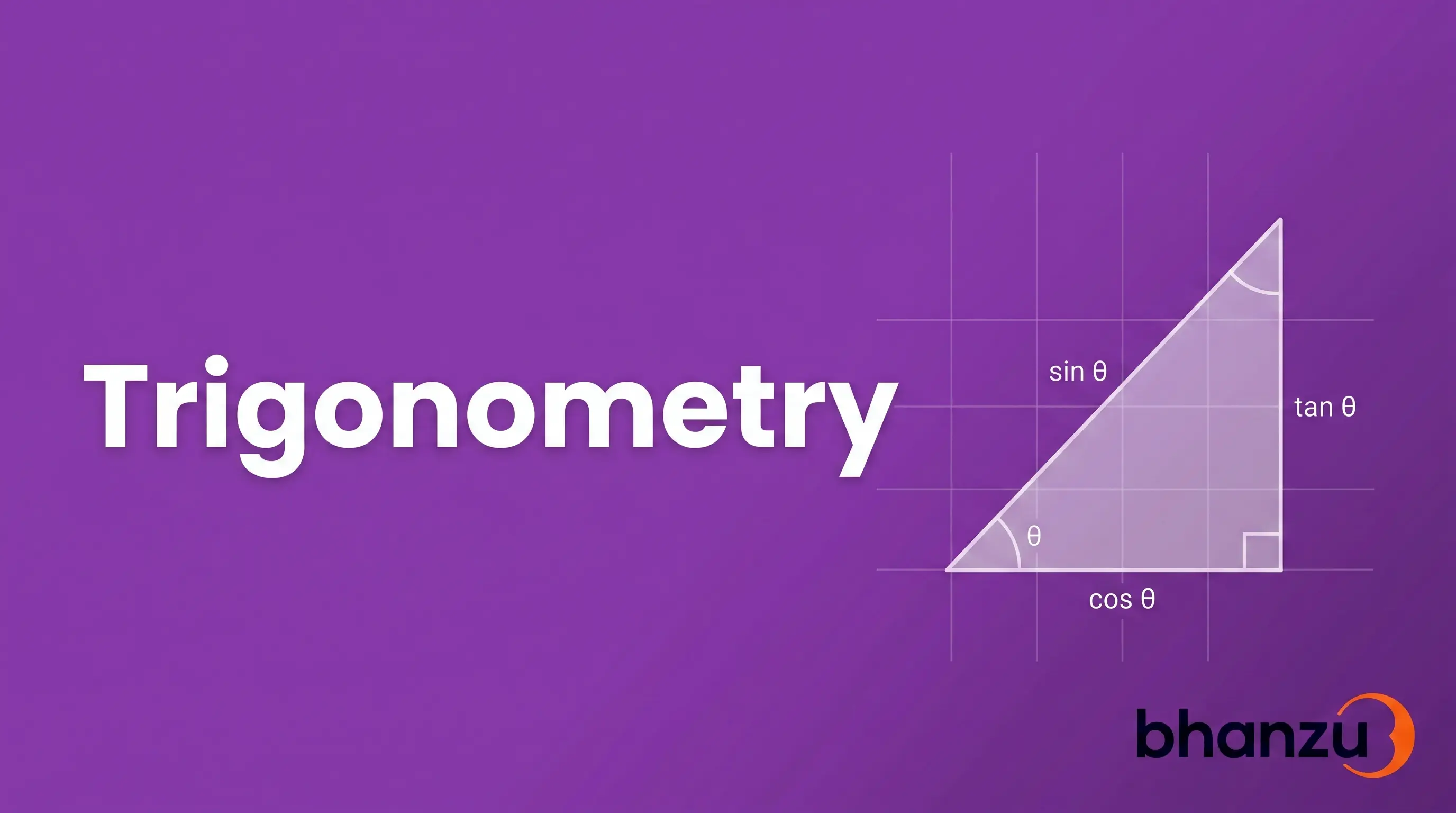
Cosine is one of the three trigonometric ratios - in a right triangle it is the side adjacent to the angle over the hypotenuse. The angle is in radians, where a full turn is $2\pi$; since $\dfrac{\pi}{6}$ is a twelfth of $2\pi$, it is a twelfth of a full turn, or $30^\circ$.
On the unit circle - radius $1$, centred at the origin - cosine is the $x$-coordinate where the angle's radius meets the circle. At $\dfrac{\pi}{6}$ that point is $\left(\dfrac{\sqrt{3}}{2}, \dfrac{1}{2}\right)$, so the cosine is $\dfrac{\sqrt{3}}{2}$.
Where Does Cos Pi/6 Show Up?
Radians make $\dfrac{\pi}{6}$ a natural clock unit: the hour marks on an analog clock face sit exactly $\dfrac{\pi}{6}$ radians apart, so each hour hand step is this angle. Any rotation counted in twelfths of a turn lands on a multiple of $\dfrac{\pi}{6}$.
In physics, $\dfrac{\pi}{6}$ often appears as a phase in oscillations and waves, where $\cos\dfrac{\pi}{6} = \dfrac{\sqrt{3}}{2}$ scales the horizontal reach of a rotating vector. The exact value lives on the unit circle, the reference every special angle is read from.
Standard-Angle Reference Table
$\dfrac{\pi}{6}$ is one of a handful of radian angles whose cosine has a clean exact form. Here are the standard first-quadrant angles in radians and degrees.
Angle (radians) | Angle (degrees) | $\cos\theta$ (exact) | $\cos\theta$ (decimal) |
|---|---|---|---|
$0$ | $0^\circ$ | $1$ | $1.0000$ |
$\dfrac{\pi}{6}$ | $30^\circ$ | $\dfrac{\sqrt{3}}{2}$ | $0.8660$ |
$\dfrac{\pi}{4}$ | $45^\circ$ | $\dfrac{\sqrt{2}}{2}$ | $0.7071$ |
$\dfrac{\pi}{3}$ | $60^\circ$ | $\dfrac{1}{2}$ | $0.5000$ |
$\dfrac{\pi}{2}$ | $90^\circ$ | $0$ | $0.0000$ |
Reading down the column, cosine shrinks from $1$ to $0$ as the angle opens. $\dfrac{\pi}{6}$ sits near the top, so its cosine $\dfrac{\sqrt{3}}{2}$ is close to $1$ - the smallest of these angles keeps the largest cosine.
How Do You Find The Exact Value Of Cos Pi/6?
Two clean routes give the same answer: one from a triangle, one from the unit circle. Both give $\dfrac{\sqrt{3}}{2}$.
Method 1: The 30-60-90 triangle.
Take an equilateral triangle with each side $2$ and drop a perpendicular from one vertex to the opposite side. That splits it into two right triangles, each with angles $\dfrac{\pi}{6}$, $\dfrac{\pi}{3}$, and $\dfrac{\pi}{2}$ radians.
In one of those right triangles:
the hypotenuse is $2$ (a full side of the equilateral triangle),
the side opposite $\dfrac{\pi}{6}$ is $1$ (half of the split base),
the side adjacent to $\dfrac{\pi}{6}$ is $\sqrt{3}$, from $\sqrt{2^2 - 1^2} = \sqrt{3}$.
Apply the definition:
$$\cos\frac{\pi}{6} = \frac{\text{adjacent}}{\text{hypotenuse}} = \frac{\sqrt{3}}{2}$$
Method 2: The unit circle.
Set the radius to $1$ and rotate it $\dfrac{\pi}{6}$ radians above the positive $x$-axis. The tip lands at $\left(\dfrac{\sqrt{3}}{2}, \dfrac{1}{2}\right)$.
$$\cos\frac{\pi}{6} = x\text{-coordinate} = \frac{\sqrt{3}}{2}$$
This is the radian-first view of the value the cos 30 degrees article derives degree-first - the same point on the same circle, entered through radians instead of degrees.
Examples Of Cos Pi/6
Example 1
Evaluate $4\cos\dfrac{\pi}{6}$.
$$4\cos\frac{\pi}{6} = 4 \times \frac{\sqrt{3}}{2} = 2\sqrt{3} \approx 3.464$$
Example 2
A student writes $\cos\dfrac{\pi}{6} = \dfrac{1}{2}$, reasoning that "$\dfrac{\pi}{6}$ is the smallest special angle, so it should give the smallest value." What is wrong, and what is the correct value?
Wrong attempt. Pairing the smallest angle with the smallest cosine gives $\cos\dfrac{\pi}{6} = \dfrac{1}{2}$.
That breaks the pattern of cosine: cosine is largest near $0$ and shrinks as the angle grows, so the smallest angle should give the largest cosine, not the smallest. The value $\dfrac{1}{2}$ is actually $\cos\dfrac{\pi}{3}$.
Correct. From the 30-60-90 triangle, $\cos\dfrac{\pi}{6} = \dfrac{\sqrt{3}}{2} \approx 0.866$, close to $1$ — exactly what a small angle should produce.
Example 3
A right triangle has a hypotenuse of $12$ cm and an angle of $\dfrac{\pi}{6}$. Find the side adjacent to that angle.
$$\cos\frac{\pi}{6} = \frac{\text{adjacent}}{12} \implies \text{adjacent} = 12 \times \frac{\sqrt{3}}{2} = 6\sqrt{3} \approx 10.39 \text{ cm}$$
Example 4
Verify the Pythagorean identity at $\dfrac{\pi}{6}$: show $\cos^2\dfrac{\pi}{6} + \sin^2\dfrac{\pi}{6} = 1$.
$$\left(\frac{\sqrt{3}}{2}\right)^2 + \left(\frac{1}{2}\right)^2 = \frac{3}{4} + \frac{1}{4} = 1$$
The Pythagorean identity holds for every angle, radian or degree.
Example 5
Confirm $\cos\dfrac{\pi}{6} = \cos 30^\circ$ by converting the radian angle to degrees.
Since $\pi$ radians $= 180^\circ$:
$$\frac{\pi}{6} \text{ rad} = \frac{180^\circ}{6} = 30^\circ$$
So $\cos\dfrac{\pi}{6} = \cos 30^\circ = \dfrac{\sqrt{3}}{2}$ — the radian and degree forms are two labels for one angle.
Where Students Trip Up On Cos Pi/6
Mistake 1: Pairing the smallest angle with the smallest cosine
Where it slips in: Guessing special values by ordering angles instead of recalling the triangle.
Don't do this: Writing $\cos\dfrac{\pi}{6} = \dfrac{1}{2}$. That is $\cos\dfrac{\pi}{3}$, the value for the larger angle.
The correct way: Anchor on "cosine starts at $1$ and shrinks." The smallest angle $\dfrac{\pi}{6}$ keeps the largest cosine, $\dfrac{\sqrt{3}}{2}$.
Mistake 2: Swapping cos pi/6 with sin pi/6
Where it slips in: Reading the unit circle point $\left(\dfrac{\sqrt{3}}{2}, \dfrac{1}{2}\right)$ and grabbing the wrong coordinate.
Don't do this: Reporting $\cos\dfrac{\pi}{6} = \dfrac{1}{2}$, which is the $y$-coordinate - that is $\sin\dfrac{\pi}{6}$.
The correct way: Cosine is always the $x$-coordinate. At $\dfrac{\pi}{6}$, $x = \dfrac{\sqrt{3}}{2}$ and $y = \dfrac{1}{2}$, so cosine takes the $\dfrac{\sqrt{3}}{2}$.
Mistake 3: Leaving the calculator in degree mode for a radian angle
Where it slips in: Entering $\cos\left(\dfrac{\pi}{6}\right)$ while the calculator reads degrees returns $\cos(0.5236^\circ) \approx 1$, not $0.866$.
Don't do this: Trusting a value near $1$ without checking the mode.
The correct way: Switch to radian mode before entering a radian angle. The habit of confirming the mode first is the single check that prevents a wrong answer here.
Key Takeaways
Cos pi/6 equals $\dfrac{\sqrt{3}}{2}$, approximately $0.8660$ - an exact value because $\dfrac{\pi}{6}$ is a standard angle.
The 30-60-90 triangle gives it as adjacent over hypotenuse; the unit circle gives it as the $x$-coordinate at $\dfrac{\pi}{6}$.
In degrees, $\cos\dfrac{\pi}{6} = \cos 30^\circ$ - same angle, different notation.
The common slips are pairing the smallest angle with the smallest cosine and grabbing the $y$-coordinate instead of the $x$.
To take radian trigonometry further with a teacher, explore Bhanzu's trigonometry tutor or high school math tutor sessions, or browse math classes online.
Practice These Before Moving On
Evaluate $2\cos\dfrac{\pi}{6} - \tan\dfrac{\pi}{6}$.
A rotating arm sits at $\dfrac{\pi}{6}$ with length $8$ cm. Use $\cos\dfrac{\pi}{6}$ to find its horizontal reach.
Show that $\cos^2\dfrac{\pi}{6} - \sin^2\dfrac{\pi}{6} = \cos\dfrac{\pi}{3}$, and check the value.
Want a live Bhanzu trainer to walk through more radian-angle problems? Book a free demo class.
Read More

Was this article helpful?
Your feedback helps us write better content