Three Functions That Exist Only Because The Number You Know Sits On The Bottom
Three trigonometric functions exist only because sometimes the number you already know sits on the bottom of a ratio. If you know the opposite side of a right triangle and want the hypotenuse, sine gives you opposite-over-hypotenuse - the wrong way up. Flipping it every single time is clumsy, so mathematics keeps a ready-made flipped version on the shelf. That is what csc, sec, and cot are: the reciprocals of sine, cosine, and tangent, waiting so you do not have to invert a fraction by hand.
These three are the quieter half of trigonometry. You meet sin cos tan first, but the reciprocal functions are what make identities, calculus derivatives, and physics formulas come out clean instead of buried under stacked fractions.
What Are The Reciprocal Trigonometric Functions Csc, Sec, And Cot?
The three reciprocal trigonometric functions are each the reciprocal of one primary function:
$$\csc\theta = \frac{1}{\sin\theta}, \qquad \sec\theta = \frac{1}{\cos\theta}, \qquad \cot\theta = \frac{1}{\tan\theta}$$
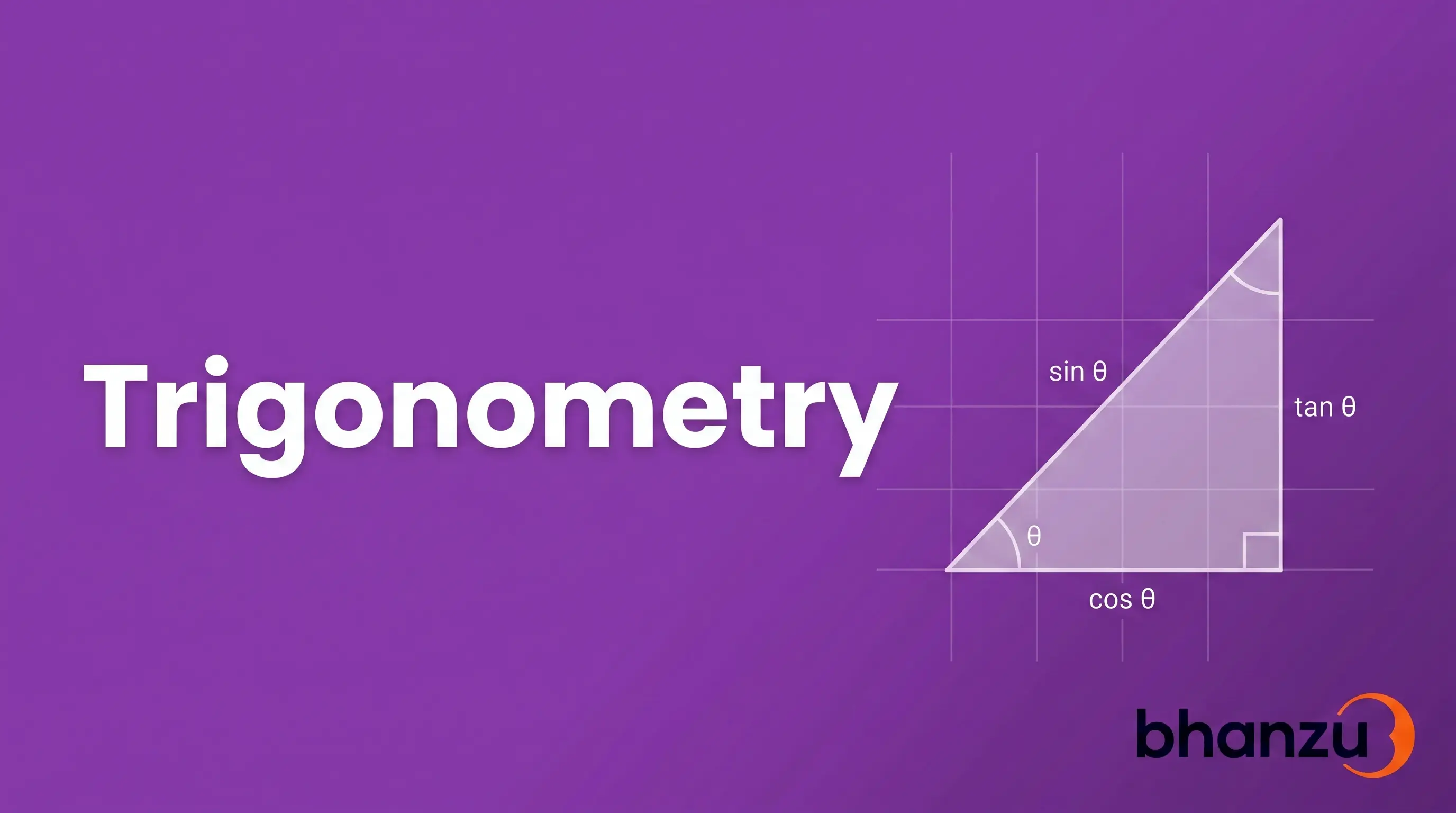
In a right triangle, they flip the primary ratios so the previously-bottom quantity moves on top:
$$\csc\theta = \frac{\text{hypotenuse}}{\text{opposite}}, \qquad \sec\theta = \frac{\text{hypotenuse}}{\text{adjacent}}, \qquad \cot\theta = \frac{\text{adjacent}}{\text{opposite}}$$
Cotangent has a second, often handier form. Since $\tan\theta = \dfrac{\sin\theta}{\cos\theta}$, its reciprocal is $\cot\theta = \dfrac{\cos\theta}{\sin\theta}$. These three definitions are the reciprocal identities, and they hold for every angle where the denominator is nonzero.
What Does Csc Sec Cot Stand For, And Which Pairs With Which?
The names are cosecant, secant, and cotangent. The pairing catches many students out, because it is deliberately crossed:
Cosecant (with the "co-") is the reciprocal of sine (no "co-").
Secant (no "co-") is the reciprocal of cosine (with the "co-").
Cotangent is the reciprocal of tangent - the one straightforward pair.
A reliable memory hook is the third letter: the third letter of cosecant is "s" (sine), and the third letter of secant is "c" (cosine). It sounds trivial, but it settles the most common naming mistake in one glance.
What Are The Properties Of Csc, Sec, And Cot?
Each reciprocal function inherits its behaviour from the primary function underneath it. The differences among the three all trace back to where sine, cosine, and tangent hit zero.
Property | $\csc\theta$ | $\sec\theta$ | $\cot\theta$ |
|---|---|---|---|
Definition | $\dfrac{1}{\sin\theta}$ | $\dfrac{1}{\cos\theta}$ | $\dfrac{\cos\theta}{\sin\theta}$ |
Domain (excluded) | $\theta \neq n\pi$ | $\theta \neq \dfrac{(2n+1)\pi}{2}$ | $\theta \neq n\pi$ |
Range | $(-\infty,-1]\cup[1,\infty)$ | $(-\infty,-1]\cup[1,\infty)$ | $(-\infty,\infty)$ |
Period | $2\pi$ | $2\pi$ | $\pi$ |
Even / odd | Odd | Even | Odd |
Two features are worth pulling out of the table:
Cotangent's range is every real number, unlike csc and sec, which skip the band $(-1,1)$. That is because cotangent is a ratio of cosine to sine, not a reciprocal of a bounded function, so it can pass through zero and take any value.
Cotangent's period is $\pi$, half that of the other two. Tangent repeats every $\pi$, and cotangent, being its reciprocal, keeps that shorter period.
The reciprocal functions also power two of the Pythagorean identities:
$$1 + \tan^2\theta = \sec^2\theta, \qquad 1 + \cot^2\theta = \csc^2\theta$$
How Do You Graph Csc, Sec, And Cot?
The dependable method is the same for all three: draw the primary function first, then read off the reciprocal.
For $\csc x$, sketch $\sin x$, drop vertical asymptotes wherever $\sin x = 0$ (at multiples of $\pi$), and draw U-shaped branches that touch $\pm 1$ at sine's peaks and troughs. The full single-function walk-through, with the branch-by-branch build, lives on the cosecant page.
For $\sec x$, sketch $\cos x$, drop asymptotes wherever $\cos x = 0$ (at odd multiples of $\dfrac{\pi}{2}$), and draw the same U-shaped branches. The secant graph is the cosecant graph shifted, because cosine is sine shifted - see the secant function for the detail.
For $\cot x$, the shape is different. Cotangent is not the reciprocal of a bounded wave; it is a decreasing curve that runs from $+\infty$ down to $-\infty$ between each pair of asymptotes at multiples of $\pi$, crossing zero at the odd multiples of $\dfrac{\pi}{2}$.
The reason csc and sec share the same U-branch shape while cot looks nothing like them comes down to what is underneath: reciprocating a bounded wave (sine or cosine) throws values to infinity and creates the U-branches, while cotangent is a ratio that slides smoothly through zero.
Where Are Csc, Sec, And Cot Used? - "Keeping identities and calculus clean"
The reciprocal functions exist for one practical reason: they put the useful quantity where you want it, so formulas stay simple. That payoff shows up most in three places.
Cleaner identities. The relationship $1 + \tan^2\theta = \sec^2\theta$ is compact only because secant exists. Written entirely in sines and cosines it becomes a cluttered fraction. The reciprocal functions are the vocabulary that keeps the trigonometric ratios legible.
Calculus derivatives. The derivative of tangent is $\sec^2 x$, and the derivative of cotangent is $-\csc^2 x$. These reciprocal-squared forms are exactly why sec and csc appear all over integral tables.
Direct triangle conversions. When you know the opposite side and need the hypotenuse, cosecant does it in one multiplication rather than a fraction inversion - the same logic that lets secant turn an adjacent side into a hypotenuse.
What most overviews skip is why cotangent behaves so differently from the other two. It is the only one of the three that is not a reciprocal of a bounded function, so it alone can equal zero and take every real value. For a compact formal treatment of all three, the open-textbook Wikibooks chapter on cosecant, secant, and cotangent lays out the definitions and identities.
Examples Of Csc, Sec, And Cot
[IMAGE PROMPT: A right triangle with angle θ, opposite = 3, adjacent = 4, hypotenuse = 5. To the right, all three reciprocal values computed: csc θ = 5/3, sec θ = 5/4, cot θ = 4/3, each with its ratio labelled (hyp/opp, hyp/adj, adj/opp). Caption: "From one 3-4-5 triangle: csc = 5/3, sec = 5/4, cot = 4/3." Alt text: Right triangle with sides 3, 4, 5 and the three reciprocal function values computed beside it.]
Example 1
In a right triangle, the opposite side is $3$, the adjacent side is $4$, and the hypotenuse is $5$. Find $\csc\theta$, $\sec\theta$, and $\cot\theta$.
Use the flipped ratios:
$$\csc\theta = \frac{\text{hyp}}{\text{opp}} = \frac{5}{3}, \qquad \sec\theta = \frac{\text{hyp}}{\text{adj}} = \frac{5}{4}, \qquad \cot\theta = \frac{\text{adj}}{\text{opp}} = \frac{4}{3}$$
Final answer: $\csc\theta = \dfrac{5}{3}$, $\sec\theta = \dfrac{5}{4}$, $\cot\theta = \dfrac{4}{3}$.
Example 2
Find $\sec 60^\circ$. First instinct, then the correct route.
The tempting move is to pair secant with sine, since "sec" and "sin" both start the same way, and write $\sec 60^\circ = \dfrac{1}{\sin 60^\circ} = \dfrac{2}{\sqrt{3}}$.
Check the pairing. Secant is the reciprocal of cosine, not sine — the crossed naming is the whole trap. So the correct denominator is $\cos 60^\circ = \dfrac{1}{2}$:
$$\sec 60^\circ = \frac{1}{\cos 60^\circ} = \frac{1}{\frac{1}{2}} = 2$$
Final answer: $\sec 60^\circ = 2$.
Example 3
Given $\cos\theta = \dfrac{2}{7}$, find $\sec\theta$.
Secant is the reciprocal of cosine, so flip the fraction:
$$\sec\theta = \frac{1}{\cos\theta} = \frac{1}{\frac{2}{7}} = \frac{7}{2}$$
Final answer: $\sec\theta = \dfrac{7}{2}$.
Example 4
Given $\csc\theta = 2$ and $\sec\theta = \dfrac{2}{\sqrt{3}}$, find $\cot\theta$.
First recover sine and cosine as the reciprocals: $\sin\theta = \dfrac{1}{2}$ and $\cos\theta = \dfrac{\sqrt{3}}{2}$. Then cotangent is cosine over sine:
$$\cot\theta = \frac{\cos\theta}{\sin\theta} = \frac{\frac{\sqrt{3}}{2}}{\frac{1}{2}} = \sqrt{3}$$
Final answer: $\cot\theta = \sqrt{3}$.
Example 5
Use the identity $1 + \cot^2\theta = \csc^2\theta$ to find $\csc\theta$ when $\cot\theta = 1$ and $\theta$ is in the first quadrant.
Substitute:
$$\csc^2\theta = 1 + (1)^2 = 2$$
Take the positive root, since cosecant is positive in the first quadrant:
$$\csc\theta = \sqrt{2}$$
Final answer: $\csc\theta = \sqrt{2}$.
Example 6
Why is $\sec 90^\circ$ undefined while $\cot 90^\circ = 0$?
For secant, $\cos 90^\circ = 0$, so $\sec 90^\circ = \dfrac{1}{0}$, which is undefined — an asymptote.
For cotangent, $\cot 90^\circ = \dfrac{\cos 90^\circ}{\sin 90^\circ} = \dfrac{0}{1} = 0$, a perfectly ordinary value.
Final answer: $\sec 90^\circ$ is undefined (division by zero); $\cot 90^\circ = 0$.
The first-instinct error students reach for across these is pairing each reciprocal with the wrong primary function — the crossed "co-" naming means secant goes with cosine and cosecant goes with sine, never the other way.
Common Mistakes With Csc, Sec, And Cot
Mistake 1: Pairing Secant With Sine
Where it slips in: Any time the similar spellings of "sec" and "sin" pull them together.
Don't do this: Writing $\sec\theta = \dfrac{1}{\sin\theta}$.
The correct way: Secant reciprocates cosine: $\sec\theta = \dfrac{1}{\cos\theta}$. The memorizer who matches by how the words sound gets this backward every time — the third-letter hook (secant has "c" for cosine) is the fix that sticks.
Mistake 2: Giving Cotangent The Same Range As Csc And Sec
Where it slips in: Assuming all three reciprocal functions skip the band $(-1, 1)$.
Don't do this: Claiming $\cot\theta$ can never be between $-1$ and $1$.
The correct way: Cotangent's range is all real numbers. It is a ratio of cosine to sine, not the reciprocal of a bounded wave, so it passes through zero and every value in between. The second-guesser who checks a value like $\cot 45^\circ = 1$ against the "forbidden band" rule and panics is applying a csc/sec rule where it does not belong.
Mistake 3: Forgetting Cotangent's Shorter Period
Where it slips in: Sketching or solving cotangent as if it repeated every $2\pi$.
Don't do this: Treating $\cot(\theta + \pi)$ as different from $\cot\theta$.
The correct way: Cotangent has period $\pi$, so $\cot(\theta + \pi) = \cot\theta$. It cycles twice as often as cosecant and secant.
Key Takeaways
Csc, sec, and cot are the reciprocal trigonometric functions: $\dfrac{1}{\sin\theta}$, $\dfrac{1}{\cos\theta}$, and $\dfrac{1}{\tan\theta}$.
The pairing is crossed: secant reciprocates cosine, cosecant reciprocates sine, cotangent reciprocates tangent.
Csc and sec have range $(-\infty,-1]\cup[1,\infty)$ and period $2\pi$; cotangent ranges over all reals with period $\pi$.
They power the Pythagorean identities $1+\tan^2\theta = \sec^2\theta$ and $1+\cot^2\theta = \csc^2\theta$.
For the single-function detail on csc alone, the cosecant deep dive carries the full graph build.
To take csc, sec, and cot further with a teacher, explore Bhanzu's trigonometry tutor sessions, a high school math tutor for graphing practice, or live math classes online with peers from 20+ countries.
A Practical Next Step
Practice these to solidify your understanding: from a $5$-$12$-$13$ right triangle, write all three reciprocal values, then evaluate $\csc 45^\circ$, $\sec 45^\circ$, and $\cot 45^\circ$ from memory. If a pairing feels shaky, come back to the third-letter hook above. Want a live Bhanzu trainer to work these through with you? Book a free demo class.
Read More
Trigonometric Functions — the six functions and how the reciprocals fit among them.
Domain and Range of Trigonometric Functions — the input and output bands for all six.
Trigonometric Table — the special-angle values you flip to get csc, sec, and cot.
Cofunction Identities — how each function pairs with its cofunction across complementary angles.
Unit Circle — where all six trig values come from geometrically.

Was this article helpful?
Your feedback helps us write better content