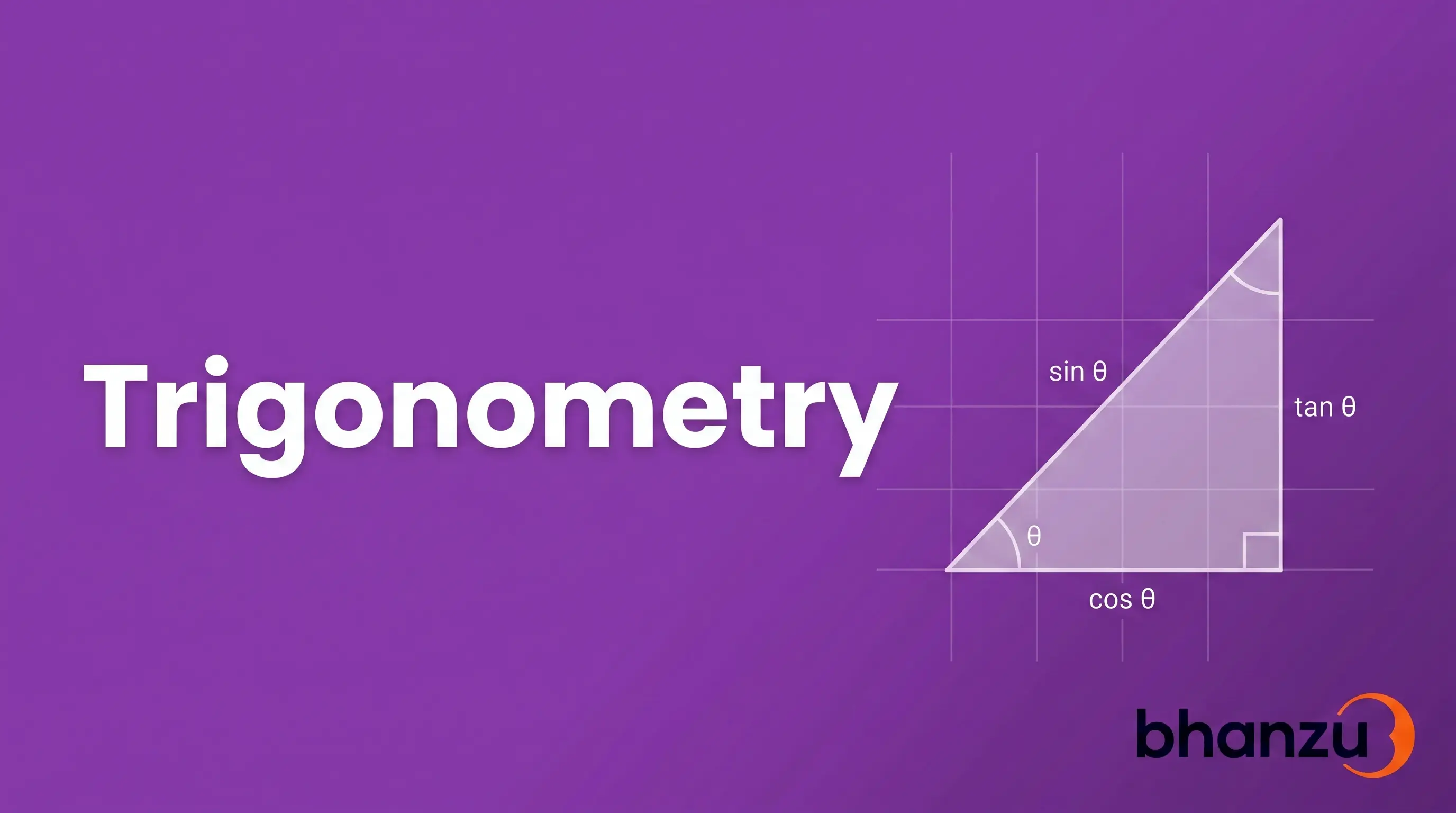
What Is The Value Of Tan 180 Degrees?
The value of tan 180 degrees is $0$. Written as an exact number it is simply $0$, and to four decimal places it is $0.0000$. In radian measure the same fact reads $\tan \pi = 0$, because $180^\circ = \pi$ radians (see what is a radian for the degree-to-radian bridge).
$$\tan 180^\circ = \tan \pi = 0$$
Every step of this article shows the angle in both forms, degrees and radians, so the value is anchored the way examiners and calculators both expect. The short derivation is the ratio definition of tangent:
$$\tan 180^\circ = \frac{\sin 180^\circ}{\cos 180^\circ} = \frac{0}{-1} = 0$$
That single line is the whole answer. The rest of the page explains where each piece comes from, why the result is a defined $0$ rather than "undefined," and how to use it without slipping on the classic traps.
How Do You Find Tan 180 Degrees?
There are three reliable routes to the value, and they all agree.
The ratio definition. Tangent is sine over cosine: $\tan\theta = \dfrac{\sin\theta}{\cos\theta}$. Since $\sin 180^\circ = 0$ and $\cos 180^\circ = -1$, the quotient is $\dfrac{0}{-1} = 0$. You can read $\sin 180^\circ$ and $\cos 180^\circ$ directly from sin 180 degrees and cos 180 degrees.
The reference angle. The reference angle for $180^\circ$ is $0^\circ$, since $180^\circ - 180^\circ = 0^\circ$. So $\tan 180^\circ$ has the same size as $\tan 0^\circ = 0$. A magnitude of zero has no sign to worry about, so the answer is just $0$. Compare with tan 0 degrees.
The allied-angle identity. Using $\tan(180^\circ - \theta) = -\tan\theta$ with $\theta = 0^\circ$ gives $\tan 180^\circ = -\tan 0^\circ = -0 = 0$. The identity confirms the same result from the algebra side.
A useful mental check: 180° is a quadrantal angle, one of the angles whose terminal side lands exactly on an axis ($0^\circ, 90^\circ, 180^\circ, 270^\circ, 360^\circ$). Quadrantal angles always give sine and cosine equal to $0$ or $\pm 1$, which makes their tangents either $0$ or undefined, never a messy surd.
Where Does 180° Sit On The Unit Circle?
On the unit circle, the angle is measured anticlockwise from the positive x-axis. Swinging halfway around, a full straight angle, lands the terminal side pointing along the negative x-axis. The point where it meets the circle is $(-1, 0)$.
On the unit circle the coordinates of that point are $(\cos\theta, \sin\theta)$. So at $180^\circ$:
$$\cos 180^\circ = -1, \qquad \sin 180^\circ = 0$$
$$\tan 180^\circ = \frac{\sin 180^\circ}{\cos 180^\circ} = \frac{0}{-1} = 0$$
There is a second, more visual way to read this. The tangent of an angle is the slope of its terminal ray. The 180° ray lies flat along the x-axis, and a flat line has slope $0$, which is exactly the shadow in the opening picture. For a deeper look at how tangent is read straight off the circle, see unit circle with tangent.
Is Tan 180 Degrees Defined Or Undefined?
This is the trap that trips most students, so it deserves its own answer: tan 180° is defined, and it equals $0$.
Tangent is only undefined when the cosine underneath is $0$, because dividing by zero has no value. That happens at $90^\circ$ and $270^\circ$, where the terminal side points straight up or straight down and $\cos\theta = 0$. At those angles, tan 90 degrees is genuinely undefined.
At $180^\circ$ the situation is different. Here $\cos 180^\circ = -1$, which is not zero, so the division $\dfrac{0}{-1}$ is perfectly legal and gives $0$. A numerator of zero over a non-zero denominator is always $0$, never undefined.
Table: The quadrantal angles, with sine, cosine, and tangent in degrees and radians.
Angle | Radians | $\sin$ | $\cos$ | $\tan$ |
|---|---|---|---|---|
$0^\circ$ | $0$ | $0$ | $1$ | $0$ |
$90^\circ$ | $\tfrac{\pi}{2}$ | $1$ | $0$ | undefined |
$180^\circ$ | $\pi$ | $0$ | $-1$ | $0$ |
$270^\circ$ | $\tfrac{3\pi}{2}$ | $-1$ | $0$ | undefined |
$360^\circ$ | $2\pi$ | $0$ | $1$ | $0$ |
Read down the last column: tangent is $0$ exactly when sine is $0$, and undefined exactly when cosine is $0$. The radian form $\tan\pi = 0$ appears at tan pi, and the full set of standard values lives in the trigonometric table.
Why Is Tan 180 Degrees Equal To 0?
The value is not a coincidence of one formula. Three independent viewpoints all force it to be zero.
The point is flat. The 180° terminal side lies along the negative x-axis, so its height above the axis (the sine) is $0$. Tangent divides that height by the horizontal part, and zero divided by anything non-zero is zero.
The slope is zero. Tangent is the steepness of the terminal ray. A ray lying flat on the x-axis has no rise, so its slope, and therefore its tangent, is $0$.
The period repeats it. Tangent has a period of $180^\circ$, meaning $\tan(\theta + 180^\circ) = \tan\theta$. Since $\tan 0^\circ = 0$, it follows that $\tan 180^\circ = \tan(0^\circ + 180^\circ) = 0$ as well. The graph of tangent crosses zero at every multiple of $180^\circ$.
All three agree because they describe the same picture from different angles: a flat direction has zero steepness, and tangent measures steepness.
Who Discovered The Tangent Function?
The tangent did not start as a curve on a graph. It started as a shadow. Ancient astronomers measured the length of the shadow that a vertical stick, a gnomon, cast on flat ground, and the ratio of that shadow to the stick's height is exactly what we now call the tangent (and its partner, the cotangent).
Two more figures shaped the same story:
Al-Battani (c. 858–929, Harran, in present-day Turkey) compiled careful shadow tables and trigonometric results that European astronomers relied on for centuries.
Aryabhata (476–550, India) produced one of the earliest sine (jya) tables around 500 CE, the foundation the whole ratio system, tangent included, is built on. His work feeds directly into the modern tangent function.
Where Is Tan 180 Degrees Used In The Real World?
A single value like tan 180° rarely appears alone, but the angle it marks, the half-turn, and the zero-slope idea behind it show up across science and technology.
Waves and sound: many signals repeat every half cycle with a sign flip, and 180° (a half turn, $\pi$ radians) is the standard "phase" at which two waves cancel, the principle behind noise-cancelling headphones.
Navigation and GPS: a bearing reversal of 180° means "turn to face the exact opposite direction," and the flat, zero-slope geometry of the straight angle is how a heading of due west is represented.
Computer graphics: rotating an object by 180° flips it end for end, and the tangent-as-slope idea drives how surfaces are shaded and how lines are drawn on screen.
Engineering and physics: the tangent measures the gradient of a ramp or a graph, and a gradient of $0$, the tan 180° case, marks a perfectly level surface with no incline.
The thread running through all of these is that tangent measures steepness, and the 180° direction is the flat one.
What Are The Most Common Mistakes With Tan 180 Degrees?
These four errors account for most lost marks on this value. Each is fixed by the same habit: read the angle off the unit circle before you compute.
Calling tan 180° undefined.
Where it slips in:
A student remembers that "tangent is undefined at the axes" and applies it to $180^\circ$ the way it applies to $90^\circ$.
Don't do this:
Do not assume every quadrantal angle breaks tangent. Undefined happens only when cosine is $0$.
The correct way:
Check the cosine first. At $180^\circ$, $\cos 180^\circ = -1 \neq 0$, so $\tan 180^\circ = \dfrac{0}{-1} = 0$ is defined. Undefined is reserved for $90^\circ$ and $270^\circ$.
Using the calculator in the wrong mode.
Where it slips in:
A student types $\tan(180)$ with the calculator set to radians and reads off $\approx 1.3386$, which is $\tan$ of $180$ radians, not $180^\circ$.
Don't do this:
Do not evaluate a degree angle while the calculator is in radian mode.
The correct way:
Set the calculator to DEG for $\tan 180^\circ$, or convert first: $180^\circ = \pi$ radians, and evaluate $\tan(\pi) = 0$ in RAD mode.
Getting the sign of tangent wrong in the second quadrant.
Where it slips in:
While working near $180^\circ$, a student assumes tangent is positive because sine is positive there.
Don't do this:
Do not read tangent's sign from sine alone. In the second quadrant (angles between $90^\circ$ and $180^\circ$), tangent is negative because cosine is negative.
The correct way:
Use the ASTC rule: only Sine is positive in the second quadrant, so tangent is negative there. Exactly at $180^\circ$ the value is $0$, the boundary between negative and positive.
Misreading the reference angle as 180°.
Where it slips in:
A student takes the reference angle of $180^\circ$ to be $180^\circ$ itself and looks up the wrong row.
Don't do this:
Do not skip the reference-angle subtraction for a quadrantal angle.
The correct way:
The reference angle for $180^\circ$ is $180^\circ - 180^\circ = 0^\circ$, so $\tan 180^\circ$ matches the size of $\tan 0^\circ = 0$.
Practice Problems On Tan 180 Degrees
Work each one, then check against the answer that follows.
Evaluate $\tan 180^\circ$.
(Answer: $0$.)Evaluate $3\tan 180^\circ + 5$.
(Answer: $3(0) + 5 = 5$.)Evaluate $2\tan 180^\circ - \cos 180^\circ$.
(Answer: $2(0) - (-1) = 1$.)Use $\tan(180^\circ - \theta) = -\tan\theta$ to find $\tan 135^\circ$.
(Answer: $-\tan 45^\circ = -1$.)Use the period rule $\tan(180^\circ + \theta) = \tan\theta$ to find $\tan 240^\circ$.
(Answer: $\tan 60^\circ = \sqrt{3} \approx 1.7321$.)Write $\tan 180^\circ$ in radians and state its value.
(Answer: $\tan \pi = 0$.)
Where Should You Go Next After Tan 180 Degrees?
Tan 180° is one landmark on the unit circle, and several natural doors open from here.
Tangent function. See how the whole tangent curve behaves, where it hits zero, and where it shoots to infinity at the undefined angles.
Unit circle with tangent. Read every trig value straight off one diagram, the fastest way to stop memorising and start seeing.
Sin cos tan. Lock in how the three core ratios connect, so values like this one become obvious rather than looked-up.
If your child is building these foundations, a live Bhanzu trainer teaches trigonometric values starting from the unit circle, the "why" behind each value, in the Bhanzu trigonometry program.

Was this article helpful?
Your feedback helps us write better content